Starting a Private Practice: Lessons in Daily Operations
About this episode
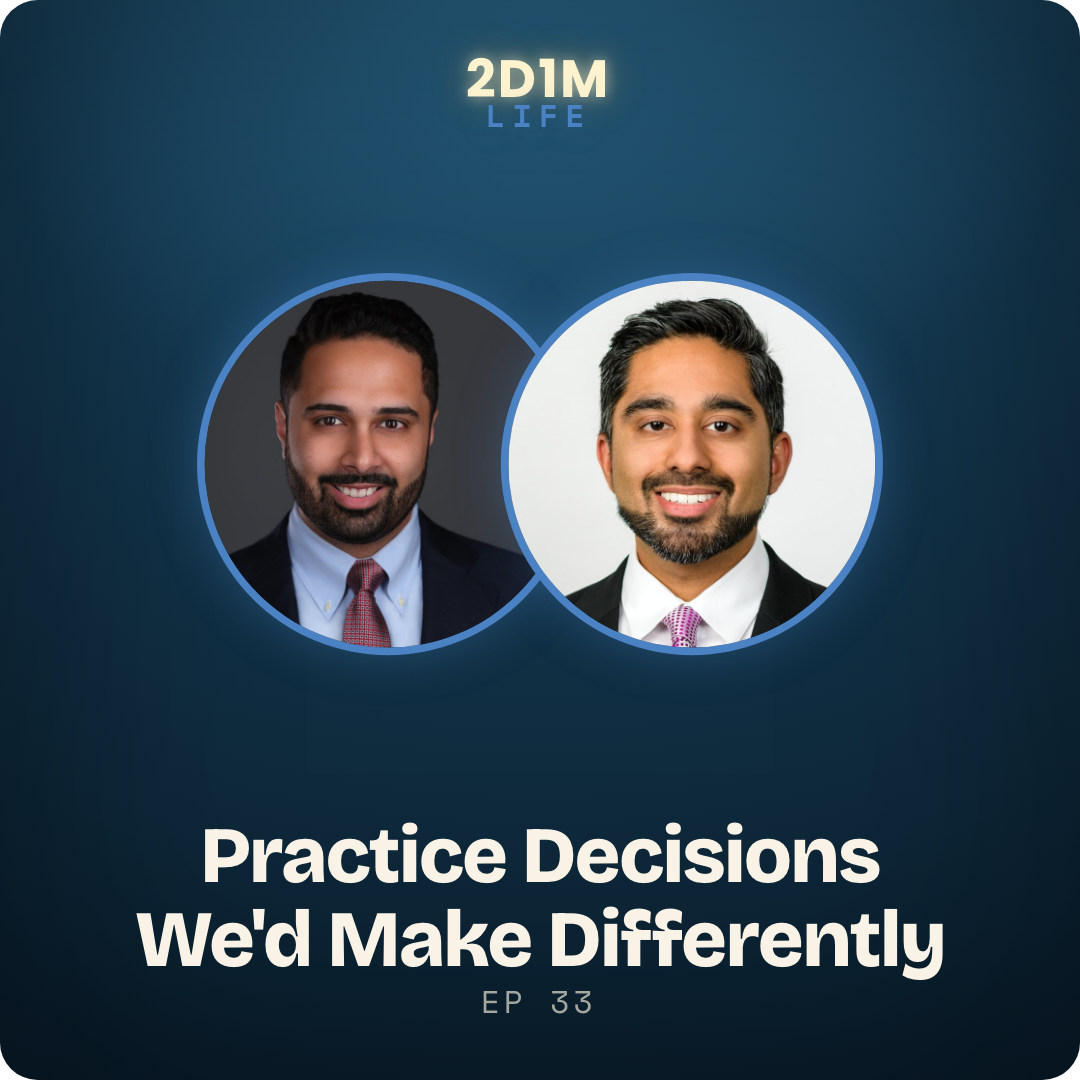
Dr. Humayun Naqvi and Dr. Adil Ahmed compare the operational work of starting and running an independent medical practice. Humayun reflects on intake, technology, staff expectations, and the choices he would revisit; Adil describes IT quotes, hiring, buildout delays, and preparing to leave an academic salary. They close by comparing the benefits and trade-offs of going independent straight after training versus first working in an established practice.
What we cover in this episode
- Pickleball and the pre-practice catch-up
- Two different stages of practice ownership
- Patient intake and chart organization
- Choosing technology that works together
- Vendor pitches versus implementation
- Hiring and the work of reviewing applicants
Full transcript
Humayun: I lost the guys. But that's why if people see Adil: Yeah, I'm I'm not a I'm not a pickleballer. Humayun: sh some shiny skin or something that's likely just me sweating. Adil: Bro, that's just your natural glow, dude. That's the skin routine. Humayun: yeah, you know the the Humayun: my nightly skin routine that I've been doing with moisturizer and cleanser and all that stuff is paying off now. I Adil: Yeah. Yeah, there you go. Humayun: need to be better about that.
just you know, most nights I get lazy and I I don't do anything, so you know. Adil: Dude, Adil: I never do anything. I haven't had any so called skin routine. Humayun: Yeah, I think is Humayun: you you've got the natural skin dude. But you know Yeah. You gotta age like fine wine. Right. but yeah it's Adil: Yeah, I don't know about that. The skin of dry shaving. It's it's just Yeah, exactly. But yeah, dude, pickleball's I'm sure pickleball was fun. Humayun: it's fun, dude, it's good workout.
you know. Adil: Yeah. Humayun: I think we're getting good as a group. Like, you know when we started playing two years ago, I think all of us were pretty bad. you know, we're just kinda winging it. But now most of us have gotten pretty good. Humayun: and playing against it and now you see other people playing, you're like, that's a rookie right there. So Yeah, just a noob. So and someone Adil: Just a noob. Yeah.
Humayun: and someone who hasn't played for a while, they come back and they're just like, man, they're gonna just slow down the game. Yeah, yeah, we we just remove you from the group text too. They're like Yeah. Yeah. Yeah, you keep once and Adil: Yeah, that's I guess that's why I don't get invited anymore. Yeah, exactly. I think I came only one time. I was like, yeah. Humayun: then you're just like, Yeah, this is not for me. Yeah. Adil: Yeah, honestly it seemed a little lame, but that's just me.
Humayun: I think I think you came when we were just very new and we weren't playing it like the right way we're supposed to. But Adil: Yeah. Humayun: it gets very competitive, it's fun. but you know, it's one of those fads. I don't know how long it'll stay, but the amount of places that are going out now in terms of pickleball places that are going up in every neighborhood, I mean it seems like it's here to stay. Adil: dude, people love it. Yeah. I th I mean I think it's a good pass.
It's better than nothing. You know, it's it is exercise. Humayun: I haven't seen any sport Humayun: take off like that in a while. Like right, I mean there's no sport in our lifetime that's come up and has become so ubiquitous. Like it's everywhere. Adil: Yeah, it's been very rapid, but you know, I think it's been rapid because it's not really like something that is reliant on an audience. It's not a TV based entertainment sport.
It's it's something that people just are playing for fun in a pastime, especially an older population. You know, I Humayun: Yeah. Adil: I think that's why it's really picked up, because it gives Humayun: I think it's Adil: older people something to do. Humayun: it's easy to pick up. It there's the barrier to entry is much lower. and anyone can play it, they can make whatever of it.
Like if someone young and competitive wants to play, they can make the game really competitive and and if someone old who wants to take it easy wants to play, they can make it like that too. So it's I think it's easy. That's why it's gotten picked up. But it's been you know, that's why I kinda rushed because I feel like Humayun: You know, I think it's it's hard to find time. and I've been thinking about this.
I know we've been doing this series on practice and you know, running your practice and starting your practice and you're going through it in a very new way. Like, you know, you're just starting out and I was just talking to you other day, like, you know, we've we've gotten calls. Both of us have gotten calls from other people, other doctors that are Humayun: They watch the episode and they want to Adil: Yeah. Humayun: start their own practice as well.
And there there's a there's a trend in our industry of doctors wanting to be independent and kinda thinking about ownership, right? in Humayun: we both talk to each other you know, people and you know, we're at different phases.
Like, you know, I'm five this is my fifth year of practice and what I'm the things the problems I'm dealing with right now, the operational issues that I'm dealing with are more related to growth and how to kinda deal with that growth and how to make sure the patient satisfaction stays that when you grow versus what you're doing is very new and kinda setting those you know foundation to your practice to make sure Adil: Yeah, it's just the groundwork Adil: right now for me.
It's not even not even anything yet. Yeah. Humayun: Yeah. So Yeah, you're laid the groundwork and you know, Humayun: I'm kinda reaping benefits or regretting some of the groundwork I laid back in the day, like right. I mean you the the things Adil: Well Humayun: that you do initially in your practice go a long way.
I mean you can always pivot and make changes, you know, operationally as you go, but I mean there's stuff I know now that Humayun: I wish I knew when I first started, and the way I would have set up my practice would have been much different than what it is now. And then once you're like really deep into the practice and things are flowing and you're busy and you don't have much time outside of patient care, then it's really hard to make that big change, right?
So it's good to set those Humayun: foundations early and that's why I think this podcast episode can be useful for a lot of people who are starting out or are thinking about starting out to s figure out some ways how they want to set their practice up for the future and what they can do to kinda, you know, set themselves up s success. But there's no one right answer to anything, right? That's how I feel about operations. Adil: Yeah, I mean I g every practice is run differently.
but you know l let's just start right there. I think you mentioned something interesting, you know, like there's a lot of things that you've done well, a lot of things that you in hindsight you think, man, if I could start all over, I would have definitely not done that or done this differently. What give give me an example? Like what is something that you wish you could have changed or if you would go back you would do in a different way.
Humayun: I mean one thing that kinda comes up as an issue later on is I wish I set up the intake protocols initially much better, how we intake patients and get collect patients information. When I was first starting, you know, I just wanted to get started and move on and do things Humayun: and solve problems as they came. I didn't really plan as Adil: Yeah.
Humayun: much because honestly I didn't have too many people that had done that and I didn't have anyone to guide me or what things will matter, right? So I would do something and a problem would come up and I would just make a change in in my operations based on that and then we'd deal with that and something else would come up and I would make a change and pivot. and I wish one of the things that I keep seeing now is some of the patient information.
Humayun: in how the patient information is organized. Adil: Yeah. Humayun: you know, their Humayun: intake forms, the consents that they're signed, the imaging that comes in. I wish I set up better processes to intake those and organize and organize them in patient charts and create good protocols for the staff so they know exactly what to do when someone comes in. Like if someone gets a right now if you look at my patient charts, things can be disorganized.
Like an echo can be under different folders in one patient versus the other. you know, some patients might have one intake form versus some patient might have an older intake form. so Adil: Yeah. Humayun: kind of Humayun: Creating those processes early on to organize your patient charts. that's something I I'm kinda dealing with nowadays where I'm like trying to organize them, making sure the the documents we have are organized for the patient.
And that's it's much of a bigger task now going back and fixing things than like if we had done it right from the start, right? That's Adil: You know, that's a difficult Adil: thing in general, right? Is like to like I guess anticipate and preempt what the future is gonna look like and like what the data layout is gonna look like and to try to set the groundwork at the beginning.
I mean, I think that's very challenging to do because you just don't really know how many patients, what the volume is gonna be, all the different iterations that could come in. Adil: This person may need an echo for one reason, this person may not need it for maybe three visits and that you know, like I I think that's very challenging. I it would be a hard thing to do. You would have to account for a lot of different variables at the very beginning. Humayun: Yeah.
Yeah that then you know, some of the well some some of the decisions you make early on, like you know Humayun: How to set up your technology, like how to set up your IT services, you know? How will you communicate with the staff? Are you going to go on Google Workspace? Are you going to do Microsoft Azure or Microsoft Teams and kind of set the Outlook and Teams as your communications? what kind of shared drive will you be doing? What kind of security aspects in your system will you be choosing?
And then the other thing is the you know, the EMR and the PACS. Humayun: system like choosing those and making sure you choose something that communicates together and works together well. In the beginning I didn't think those things would matter as much, you know, and and the cohesion of all the technologies that you employ in your practice. I think and I think in at in that time I was like okay like this is cheaper, let's just go it this way.
Like you know you're so focused on the cost in the beginning that you try to save cost and cut costs and maybe go for a cheaper option initially because you're worried about your Humayun: expenses you're worried about how much money you'll be spending and when you'll be making money you you start out but you know sometimes it's better to invest early on and get the nicer things early on and set things up right so long term you're more your your base is stronger.
And I think you always get what you pay for, you know. Humayun: that's the one thing I've learned. I mean in terms of quality, like when you pay for something and pay for the services, you'll get the right service if you cut corners and try to go for the cheap options, you'll always end up paying more for it in the end.
Adil: Yeah, and you know, that's interesting because it's kind of a different way to look at the like the mindset that's been ingrained so much in everyone I've talked to, you know, like basically starting this practice right now is like keep costs down, you know, keep overhead down. That's like the mantra that I've just heard again and again.
But what you're saying is it's not necessarily the opposite of that, but it's that, you know, in certain things you kind of just have to pay a little bit more and maybe not Adil: y get so hung up on keeping overhead low in every little thing. Yeah, cause what you're saying, like a just that example you gave, like IT services.
Like I just signed with an IT company to do all of that stuff, set up the network, the servers, the backup, the security, the firewalls, the compliant all that all that stuff. And I mean the range of like the monthly cost for IT services for a practice, which is a single doctor practice with just a couple employees, I mean it was anywhere from like four hundred bucks a month. Adil: To like fourteen hundred dollars a month, and I was like, that's a that's a huge range.
And they have so many offer you read the like quote. I mean it's like an eight page thing like this, this, the I'm like, I don't even know what the hell half of this stuff is. And it's like, do I go with the Cadillac version? Do I just like go with the really cheap option right now and switch later? But like you said, switching later is a huge issue, just like you are encountering with your intake form. So Humayun: Yeah. Adil: that's it it's a difficult balancing act, I think.
especially like for my shoes, starting out Adil: without a big revenue coming in monthly that's consistent, to say like, well yeah, sure, I'll pay a little more for that. Yeah, I'll pay a little more for that. I mean that little more, little more i it really adds up. Humayun: Heads up. Just remember, and whenever you're dealing with a lot of these vendors, right, their marketing department is always the best department for that company.
Anyone that's going to come and pitch you, they're gonna say all these things, yeah, we'll be available for you. And you know, we're we're we're going to be available on the first call. This these are services, everything will be working you know, like it's meant to. It'll all connect and we'll provide the most premium services to you and the cost will keep it down.
Humayun: But once you sign the contract, and it comes times for execution, like, you know, those those great marketers and those great salespeople that initially you talk to they disappear. And you get you get Adil: They disappear. Yeah. Right.
Humayun: you get you know, handed over to the implementation specialist that is nowhere to be found and things move slow and so this is a lesson I've learned over and over and I feel like Humayun: Yeah, I just keep making the same mistakes sometimes where I see a salesperson, they give a pitch, things are just amazing and the way they're pitching the product and the service, it's it's great and I'm like, Okay, let's do it and then I found out when it comes to implementation, I'm not even surprised anymore.
And it's always Adil: Yeah. Humayun: the case, you know, just just be I think and I think that's where the word of mouth comes in play where there's services that you know that people you know that have worked with and they know they're reliable and they'll do a good job.
that's kinda like Humayun: now I've learned that that's the way to move forward because a lot of people say all these great things in the beginning and when it comes to implementation and and execution there that's not never never matches the initial pitch. Adil: Yeah. Humayun: that's a big lesson to learn and when you whenever you're starting any business, not just just a practice. Yeah. Adil: No, for sure. That's true. You know, one other thing that I think yeah, go ahead. What were you saying?
Humayun: It's kinda same No, the Humayun: same same kind of thing with employees, right? you know, I think when you're kind of doing the hiring and going through the resume, every resume looks amazing, right? Adil: Yeah. Humayun: Especially nowadays in the in the presence of Claude and ChatGPT. Adil: 'Cause everyone's just made by Adil: like Claude or ChatGPT. It's like yeah. Yeah. Humayun: Yeah, I mean I mean look look at the LinkedIn profiles of people, right?
I mean, you could Humayun: be you could just have a desk job, but you could be a sales executive, implementation specialist, you know, senior level. Can you can write all these fancy words in your in your LinkedIn? Adil: I know, I like everyone is the Adil: CEO of their cubicle, you know, it's just like Humayun: Yeah.
So Humayun: when someone comes in and sends a resume and CV or like, wow, they've done they they worked at this cardiology practice where they've done the stress tests and they write EKGs and they write ABIs and they they pretty much write all the services and everything that was present at the cardiology practice. Now how much do they know how to do it? That's a different story.
A lot of times when when the practice starts and when they come in and they start working, you f realize that they never did any of those things and you have Adil: Yeah. Humayun: teach them. Like they they just saw those being done. Humayun: They they saw that you know, in the practice they were doing that, so they just wrote that on their resume, but that's not and you know, that's always the case.
So it's very I think any doctor, any any physician that's running the practice, any management person that's running a practice will tell you finding the right s right staff and doing HR and hiring and managing employees is is one of the hardest thing you'll do as a as a when you're running a practice.
Adil: Dude, you know the that's so funny because I like I just last week hired my X-ray tech and you know I like asked round word of mouth, whatever, but like you know, front office or MA positions are I think easier to find word of mouth, X-ray tech, a little more niche, a little more like certification involved. And i so I just put a posting on Indeed. A very simple posting, like hey, this is a Adil: Orthopedic surgery private practice based in West Houston, blah blah blah, this, this and this.
And I'm looking for an X-ray tech. Dude, I'm not kidding. Like I shut it I shut the Indeed thing off after the first day. Like I think it was like thirty hours. There was like twenty one applications that were whatever number, like a bunch came through. You can't even sift through it, right?
But then like when I started doing a little more due diligence and I had you know had some AI help and all this stuff, but sifting through the applications, trying to make like a scoring system, whatever, I found out that so many Adil: Applicants had just BS’d their credentials. Like like one did one candidate had six concurrent jobs. Just the timeline that they themselves put on their own resume. I was like, you can't like it's impossible. You can't have six full-time jobs. Like you just don't.
And Humayun: Yeah. Adil: and like another candidate, I I was actually gonna give them a phone interview offer because everything looked really good. Adil: And then I saw that the credentials that they posted, you know, like their full name is on there, so I checked the credential number with like the Texas Medical Board, the state website, 'cause they have to be licensed. And their license has been expired for like four years.
And it's just like you don't even have an active license, you're applying for an X-ray tech position. And they've apparently held multiple jobs as an X-ray tech in that four year span where they haven't had a license. And like no one bothered to check, Humayun: Yeah, and no one probably checked either. Adil: I guess. I I don't know. I Humayun: I bet they don't even know their license expired. Adil: Yeah, maybe not. So like I Adil: messaged that person on Indeed.
I was like, I just want to let you know, like, thank you for applying. I can't hire you, but your license has expired, and it has been since that. Their response was, I mean, and I don't know if they were being honest or just BSing their response, like, my gosh, thanks for letting me know, I had no idea. I was like, R how do you have no idea? Humayun: Yeah. Adil: But I I mean, it it's been a very interesting, fun and annoying process of hiring people.
I mean, I've never hired anybody before, but so it's it's all Humayun: Yeah. Adil: new to me. Humayun: It was very overwhelming 'cause I remember when the first initially I think when I first started hiring it we we I had some you know resumes laying around and I just interviewed a couple of people and and and we were able to hire it but when we started subsequent hiring, you know, we posted on Indeed and there was a flood of resumes.
Like people are just there and they just click, click, click and some people Adil: Yeah. Humayun: had you know, we we we wrote in our in our Humayun: requirements like you know have must have worked in the cardiology office should know how to e do EMR but there's like f five or six applicants that applied had never worked at it they were like working at Whataburger and Burger King right now like they were front like you know at the receptionist at Adil: No. Yeah, yeah.
Humayun: or like at the at the at the cash counter at at McDonald's that never had a medical assistant job or or a cardiology practice job and then the other thing that happens is and you'll I don't know if you've experienced this when you start hiring and you set up interviews Humayun: interviews like you know, you set up five interviews and three to four of them don't show up and they confirm and they tell you they will come and but you wait and you know and you know first few hires that we did, like my wife was, you know, r she was she's my office manager and she was kinda running it and she would Humayun: set up time and, you know, we would have our kids in, you know, daycare in Montessori and she would kinda find time, come in, make sure she's here in person, ready to go and, you know, with CVs and everything prepared and she would wait and wait and wait and time would be like, okay, fifteen minutes gone, twenty minutes gone and person doesn't show up.
Adil: These people just flaked out. Humayun: Yeah, what are you even telling you that they you know they they're not coming that there's a lot of unreliable people that they confirm you call them, you're like, Okay, you're gonna come tomorrow Adil: Yeah. Humayun: for a job interview. So you have to have patience for that. And if you're already busy, right, you're in you're in practice and you're seeing twenty five, thirty, forty patients today.
And now if you're trying to do the hiring yourself, you don't have time for that. There's no way you can do that. Adil: Dude, that's like it's so Adil: true. You know, like when I first made the decision to resign from academics from Baylor and go private, I like didn't really want that much of a gap between when I finished at Baylor and then started my own practice. I was like, maybe a month or less is all I want because I just wanna keep working.
I don't wanna lose patients and referrals, you know, want money keep coming in for just life. I mean all that stuff. Now I'm like, holy crap, I kinda wish I had more time because there's so much stuff Adil: That really only gets done during business hours and like like you said, I I'm still working full time. I have to until, you know, the last Humayun: Yeah. Adil: day. It it's so difficult to try to squeeze in anything during the work day.
A phone call here and there, like some demo with a payroll company on how their software works. I'm like, Well, can you do it after five PM? and then it's just like crickets. Like Humayun: Yeah. Humayun: Yeah, no one, no one. I mean they and Adil: Yeah. Humayun: and no one works on your own time. I mean you're you're in the counter phase, right?
You're in a phase where you're gonna work at eleven, you're gonna work at ten and you're in a different mindset and other people are not in that same mindset. So you know, mm you have to kinda Humayun: reset your expectations where people are not going to be moving at the same pace as you. You want things done fast. You want you want the answers right away and you'll send an email out and want answers, but people will take maybe a week to reply and you're just like, what's going on?
Like you know, I just need to get this done. you know Adil: Dude, that's Adil: like exactly exactly what I'm going through with the the construction people, like Humayun: Mm-hmm. Adil: the the the contractor to like the space has very little stuff left. It's just like one room of flooring and like painting the walls. Like it could be done in two days. And like to get this guy to respond to an email, I mean, it's just like Humayun: Mm-hmm. Adil: or or a text just won't for like four days.
And then he'll be like, yeah, we did order the tiles. Adil: And I was like, I mean, would it kill you to just tell me that four days ago? Like, just give me an update. I it's just these everyone's on their own time, I guess. Humayun: Yeah. Yeah, pe people Humayun: are on their own time and i and and once you start your practice and you know, you come up with idea and you have a plan and you have employees now, you tell them to do something, everyone's on a different timeline than you.
You want something done right now, but people will Adil: Yeah. Humayun: that for them that might not be the priority, right? So Adil: Yeah. Humayun: and you don't wanna be the micromanager where you're going on and just keep reminding employees to do something and you know, hey, like make sure you do that, make sure you do that. I hate doing that. I have to do it sometimes. But Adil: Yeah.
Humayun: people will be on a different timeline, they'll do what's their priority, their work, and for most people it's a nine to five job, right? You you'll get very lucky, and you know, I've gotten lucky where some people that I've found, where you'll get lucky where you'll find someone who will take ownership of your practice and will work with you like Humayun: they their it's their practice, they'll care for that and you can get very lucky and find someone like that.
it's very rare and you know, if you if you get lucky you'll find someone like that who'll who'll think of your patients as their patients and, you know, work hard and make make you know priority. But everyone still for them it's a job and the the for them it's eight to five when they have a day off, they have a day off. For you it's not going to like that your day off is still Humayun: You're thinking about your practice, you're still thinking Adil: Yeah.
Humayun: about the patients, you're still st you still have to pay bills. If it's a whole week of vacation you're taking, you still have to worry about you know, paying everyone, right? I mean, you know, the more employees you hire, the more life lives are depending on the income that you generate to feed their bellies, right? so you'll have to worry about that constantly.
and for most people it's nine to five, so the urgency is not there a lot of times, and you'll see that your timeline will be very different than than everyone else's. Adil: Yeah, that that'll be a more of an expectation management for myself than anything else. Humayun: Yeah. I a and it'd be frustrating Humayun: 'cause when I first started, you know, Humayun: I was just used to being around cardiologists. you know, I just came out of fellowship.
Everyone that I worked with, you know, from chief fellows that I was working with, with attendings and program and directors and everyone Adil: Yeah. Humayun: was a cardiologist. You you only dealt with other cardiologists, in your fellowship program and you didn't deal with other people.
So and and then you forget that, you know, when you're saying certain things like, I wanna order that test because this is this, you know, you're Humayun: assuming that everyone will understand what you're talking about. Right? Because you've just been around other cardiologists this whole time and other peop maybe for you orthopedic surgeons. Adil: Yeah, yeah.
Humayun: but for everyone else there's a whole there's a big gap and they a lot of times will not understand what you're even saying and what what what you want to do and why you want to do that.
You know, so there'll be a big gap in that and you'll have to understand and kinda think from their perspective how they're they're not trained cardiologists they're nothing like that and then Humayun: you'll have to kinda lower your expectations and and give people their timelines and l allow them to grow in their roles and work in their timelines. And that could be a frustrating thing too. But for someone Adil: Yeah. Humayun: like me who's very impatient Adil: Yeah.
But I guess there's no way around it. I mean you just gotta learn how to do it. You know, one other thing that like when I was thinking about this and I I would be very interested, Humayun, to hear when you were first starting, 'cause you came straight out of training, straight out of fellowship, like the cost and the expenses because life keeps happening, you know, your home, your cars, your food on the table for you and your family, school, all that stuff, that continues.
And, you know, to leave something stable, like Adil: You know, thankfully as an orthopedic surgeon in academic practice you make pretty good money. And so to walk away from that and go to zero income coming in is a big jump. And the upfront cost of a practice before the revenue starts coming in is very high, like any startup is. how how did you manage that when you were coming out of training? Because your situation was probably different than mine.
Like I've, you know, been thankfully like making a lot of money in Adil: my job before I decided to leave and have quite a bit of savings, Humayun: Yeah, I was making nothing. Adil: you were like fresh out of training. I mean it's a big difference. Humayun: Yeah. For me it was just going up, right? I was making what fifty three thousand dollars a year. You know. Yeah, resident Adil: Yeah, as like a resident and then fellow, yeah.
Humayun: my my wife was not working 'cause we just had the baby, so we were just living on that you know, fifty three Adil: that's right. You had Adil: just had [name unclear], that's right. Yeah. Humayun: Yeah, we had just had him, so she wasn't Humayun: working at the time, so we were just living off the one income and we were used to that. We were used to a low income.
And from there on, like, for me it was just a s a slow, gradual jump in my income eventually and you know, now I c I couldn't have even imagined Humayun: at that time like making this kind of money thankfully but you know at that time like for me it was did not feel much. I was like started off low, I was you know, happy with the small amount of money I was making and my and I had a little bit of savings as well, you know, from before, like slowly like saving up.
So Humayun: For me I didn't have expenses, I didn't have a mortgage, I didn't have a huge car payment. We still had like an old car. you know, my kids were not in any kind of school, my wife was home, so for me the expenses were very little. I I wasn't used to a high income. So for me it was easier.
As as someone coming out of fellowship, it's actually a lot easier because then as you build on, you're just building income on top of the low income that you already have rather than like Adil: Yeah, yeah. I guess your lifestyle Adil: you're already used to living at a Adil: Chiller lifestyle, I guess. I mean you haven't upgraded your life from when you were in training. Humayun: Yeah, you haven't.
So it's it's much easier and that's why I think like you know, most people say, that must have been stressful starting right out of fellowship. But for me it wasn't because for me like actually my income within like a couple of months of starting the practice was higher than I was making in fellowship, right? That's how little you get paid in fellowship. Like, you know what what what is Adil: Yeah, yeah.
Humayun: like fifty three thousand dollars or you know Humayun: up being what three thirty five hundred a month or something like that, three thousand you know, or something like that. So for Adil: Yeah. Humayun: for me, like, you know, just the first month of practice I probably made more than I was making fellowship. Adil: Yeah. Humayun: so Humayun: And and my expenses are very low at that time, right? You start off, you just have one employee at a at a lower income rate.
You don't have as many expenses because expenses in practice grow as you build. I had an expanded like you know, my my EMR for example, I chose eClinicalWorks. and the way it worked was it they charge you zero upfront fee and it's like Humayun: I forgot a dollar fifty per patient you see initially. So as you Adil: Yeah, yeah. Humayun: build up and as you have a lot of patients, then this they move on to a flat fee rate.
So for me really if I saw a patient it would it would cost me hundred and fifty dollars. there's a lot of there's a lot of company there's a lot of like people like you know you get rent out from people that will actually waive your first six months of rent or first three months of rent Humayun: in your practice because they know as a new practice, you're gonna be a reliable, you know, good Adil: A good tenant, yeah.
Humayun: tenant, but they they waive your first six months of rent because because they know you won't be making as much money. So there's a lot of help out there. There's a lot of ways to kind of lower your cost upfront. you know, don't get fancy station, don't get fancy have one laptop for you and your employee as a one time maybe five to six hundred dollar investment.
and then Humayun: You know, n you don't need computers everywhere in your practice and as you grow you can bring on more technology, add more services and things like that. You don't have to go big up front. But I think investing in those Humayun: The infrastructure, you know. Not the things per se, but the infrastructure is is important and that is a upfront cost that I think everyone should make developing a good infrastructure so when they when they grow, they can grow into that.
you don't have to buy new furniture, you don't have to get fancy things, you can just have a basic exam table that you can get for maybe hundred and fifty, two hundred dollars one time cost, right? So you can have three tables. You don't have to have a big five thousand square foot office. You can start off with a Humayun: one to two exam room office and then grow into that. Right.
So there's a lot of ways you can start small and I feel like when you're starting out early on, you need to be flexible. You don't need you should not invest early on into things that you'll be stuck with and now you're having to see more patients order more tests just because you invested into a machine up front. Adil: Yeah. Humayun: there's a lot of technology for example, like in cardiology we do nuclear imaging, right?
So you a lot of cardiologists they have to have a nuclear camera in their office to do stress testing. But you know, there's services that can come in and you lease a camera from them once a week and they come in and do the whole test in your office and and run the stress test and that way you don't invest so much capital into buying a machine that you know now you're you're obliged to order test on. So I think the key is staying flexible up front.
Humayun: So you can focus on just building your practice, growing your patients and being genuine with your patients, right? Not someone who's just a test ordering machine. yeah, now I s I Adil: Yeah. Humayun: spent so much money in a c you know on a stress test machine. So every patient that comes in has to get a stress test for me to make up for the cost, right? You don't wanna Adil: Yeah.
Humayun: be that guy, you don't wanna be that cardiologist or that surgeon that everyone is just getting a carpal tunnel surgery, you know, as soon as they walk into your office. Adil: Yeah, yeah, Adil: for sure. You know that you you mentioned a couple like i for that camera example you you gave, that the company will come, you can kind of rent it out once a week or whatever.
You know, I found that like working with industry vendors like that who make whether it's medical devices or imaging technology, it's like i it's very different than like on the employed side. These companies are so down. I mean, like to work with you, to give you discounts or comp stuff for you up front Adil: Or let you lease stuff for free for like three months, see if you like it. I mean, I was like ver on I was actually very blown away.
Like, there's one company that like will let me use like a full on ultrasound machine for free, like as much as I want in clinic, which is I think awesome because I love using ultrasound. I mean, you can write that in there sitting with a patient, slap it on their wrist, on their shoulder, whatever. The patient is seeing the screen live with you as you move and point out their anatomy to them. Adil: there's the rotator cuff tear. here's your median nerve for the carpal tunnel.
You like freeze, you can literally measure the cross-sectional area. I mean, it's awesome how you can instantly diagnose quantitatively and show the patient. Patients love that stuff. And they they feel like you've spent more time with them and you have. But you know, a good high-resolution ultrasound machine can be quite a few thousands of dollars. Some are even, you know, like it just depends how fancy you get. I some are over 100K.
And those things are big ticket expenses at the start of a practice. But these companies will just let you use it. Humayun: Do I have I had a salesperson? He's a very nice Adil: Yeah. Humayun: guy. Like I had known him from the beginning. you know, when I started my practice, I bought some equipment from and that's another thing I a mistake I made initially. I bought equipment from a reseller right rather than from direct vendor, direct you know, manufacturer. Adil: Hmm.
Humayun: so I bought this machine a bunch of machines from the second Humayun: hand retailer, Adil: Yeah, yeah. Humayun: you know, and I was stuck with this device and I wasn't getting good service from these people. So this sales guy I found, he was he was very helpful. He kinda came and helped me. So I built a relationship with him and I reach out to him whenever I need something. And you know, once I was like, hey, I'm looking into a market I'm in the market for a new EKG.
Can you show me a few things? And he just one day brought an EKG machine, left it there, and then for three months he disappeared. Like he just had this new EKG machine that I was just using. And a few months Adil: Yeah, yeah. Humayun: he's like, hey man, I just gave Humayun: That machine three months ago, can I just pick it up? you know, unless you're gonna buy it. I'm like, yeah, I found another EKG machine, but yeah, you can come, you can come pick it up, and you just so Adil: Right, right.
Humayun: yeah, that's a lot of that, like exactly what you're saying. People will just come and Adil: Yeah. Humayun: you know let you use things because you know they're building a relationship too. You they know as a physician, you know, you will grow, you will get busier, you'll and for a lot of vendors, you know, building a relationship with you is important. They want to provide good service to you, it's a competitive market, right?
They for Humayun: Or i in the healthcare space, there's 20 companies that are doing you know, in in just one like zip code, there's like 20 companies that are doing billing, there's Adil: Yeah, yeah. Humayun: you know, other like fifty echo techs and you know everyone wants to make sure they're reliable and you know they they and in private practice this is how it works. I mean, if you if next if tomorrow I find someone who's doing a better job, I'll I'll go with them.
So the sales rep do a great job kind of being good salespeople. a lot of time it's their operation side that fails them. You know, but Adil: Right, right. Humayun: Yeah, but there's a lot of really Adil: Yeah, but that's what I've I've Adil: just noticed like or I guess I've become more aware of it like that the vendors are very interested in making a long term relationship. I mean, they're very okay upfront dropping their cost or even comping blank amount of time for you.
If you like you're saying, you look like you're gonna be a long term customer for them. Adil: Which is very refreshing 'cause it a it it directly addresses that question of like that lag time for your revenue cycle to hit and the upfront expenses. So it it's been nice. Humayun: I would say just be open, don't be shy about it, right? Hey, you know, ask ask for it.
If you want something, you're like, hey, you know, I'm not really sure if I'm gonna use this machine, why don't you let me use it for a month? Adil: Yeah. Humayun: Most of Humayun: the time they will let you do that. Or you say, hey, I want to try it out. What can you what can you do for me? I'm starting out. I'm a new practice. What can we do to kind of grow together? And and most people, you know, there's there's interesting there's a book by Robert Greene called The Laws of Human Nature.
And in that he talks about like play to people's don't you know, ask for favors because no one wants to just do favors, play to their personal interests, right? Adil: Yeah. Humayun: if you kind of talk about and show people how you can be a benefit to them they will go along and listen to you and work with you rather than just asking for favors because asking for favors no one wants to just do favors without Humayun: knowing that there will be some personal benefit to them.
But if you can show someone that there will be a personal benefit to them, they will come along and do you favors and help you kinda get along and you know, get things for you. So understand how you can be a benefit to other people and how they can benefit you and kind of be open to discuss that, you know. Humayun: Like, you know, if I I go out of my way. If I kn like a vendor, I go out of my way to introduce them to other people. Like, you know, they've been good to me.
this is a good Adil: Yeah. Humayun: salesperson, they've been good to me. I I give five other cardiologists their references because I want to help them too, right? I mean that's I'm in the b I'm in the in the business of building relationship. I'll help you out as a vendor and work with you. and in return, you know, I'm hoping that you will be there when I need something and be available. So Adil: Yeah.
Humayun: that's how Humayun: Business is and in business, everyone's looking for their own benefit. There's no no one starts a business to just be a charity case, right? No one wants to just do charity and just provide things for free. It's because there's some personal interest there, and just know that no one is doing you a favor because they just want to do you a favor because they're generous, they're doing a favor because they see some kind of personal interest in that.
Humayun: A salesperson is coming to you because they know eventually they will get some kind of benefit out of you. So it's it's it's a it's a the world of transaction and and just know that, right? don't be ashamed of there's a lot of quid pro quo. So Adil: Yeah, it's a lot of quid pro quo. Yeah. Humayun: and and the med the the business of medicine is just like any business, right?
Though Humayun: Where the quid pro quo doesn't come in is that patient physician relationship 'cause a lot of times you know you have to kinda keep that sacred. There is a money exchange and that's one of the hardest part of you know starting a practice when you start out, you realize that, you know Humayun: when you provide a service there's a certain cost that patient has to pay, right? And there's a money exchange happening and as a physician you want to stay out of it.
Like it for me it feels kind of dirty, you know, talking about money or, you know, there's some patients they're like, hey, I s you know, your echo is like this much. Can we can you do something for me? And for those patients I'm always like, Hey, you know, just just pay whatever you can. I mean I I I don't like talking about money, just you know, because it isn't then a business.
and as a and Humayun: in academic practice, in the employed model, there's you never have that conversation, you know. a patient comes in, they see you, and then the admin takes over and they're the ones in charge of collecting and bills. Adil: Yeah, you Adil: can you can be very shielded from it. And it's it's so easy that I don't know, I'm just an employee here. Humayun: Yeah. Adil: We'll talk to the insurance people, you know, and it kinda ends the conversation. Humayun: Yeah. Humayun: Yeah.
But when it's your practice and you're the you're the owner of the practice and the patient knows that they know you can control the cost and the price they're paying. And that's kinda where the uneasiness of that relationship comes in where you know, we're Humayun: we try to work with patients and we try to provide them, you know, 'cause everyone's in cardiology, it's sometimes it's a very stressful time for patients.
When c when things go wrong with the heart, you know, it can be very stressful for a lot of patients. And it's the city's Adil: Yeah, I it's Adil: it's almost as important as when something goes wrong with the bone, it's true. Humayun: Somewhat dude. let's not let's not go there. no the bone's more Adil: I just couldn't help it. Humayun: painful though, right? If you break your bone, you're in severe pain in the in the heart it sometime can be silent as well, but you know.
Adil: I know, that's I'm Adil: just surprised they don't call fractures bone attacks. You know, they call it heart a heart attack. They should just call it a bone attack. Humayun: Bone attacks. Bone attacks.
Yeah, but Humayun: you know, that's kind of where the the issue comes in and you have to be up front and you have to separate yourself from the money side of things and you say, Hey, just talk to my staff about the compensation, I'm sure we'll be able to work something out with you and set those protocols up front, right?
which patients Adil: I think that's a really good Adil: thing, you know, that's like having a set fee schedule is really nice 'cause then I mean it it takes like a little bit of the mental gymnastics away. You don't have to at each moment of engagement with the patient who brings up that question, have to be like, damn, what could I discount for blank or this? Like you just have it set preemptively. It's the same for everybody. It's uniform so you're kinda picking and choosing.
I I think that's a very helpful thing. Humayun: Yeah. Yeah, set protocols. Like yeah, and your staff would know, like, okay, if this patient comes in and they're ha they're unable to pay so much money for their tests, why don't we have a hardship form? We have them fill out, submit that, we can lower their cost. Like there's ways of doing that. We have that control.
Now there are certain requirements, and you cannot just go on and provide Humayun: severe crazy discounts to all your patients because then you kinda become anti competitive and you know or y you know you're providing too much too competitive prices and then you know people can come after you because you're kinda gaming the system and to get more patients. So you shouldn't be doing that but you should be fair and you should have a process, right?
So yeah, for certain patients who can prove hardship we can discount them discount for them. for certain patients that's what their insurance says and why don't and what I do a lot of times that for example I Humayun: order a stress test for a patient or a cardiogram, hey, why don't we prioritize? I think this test is Humayun: number one priority and if this doesn't show us anything then maybe we can do this, right? Or I tell them give them three different options.
I was like, we can do a stress test, we can do a CT angiogram, or we can maybe do a combination of a much cheaper test, like a basic exercise treadmill test with a calcium score. And maybe you can choose this option. I think number one would give us the best answer, but number two is much cheaper and will give us somewhat of an answer.
So that's kind of where you have to you know, create protocols and options for patients because Humayun: the money side of things does get a little uneasy for me because patients come in and they you know I I they need a stress test. I mean they're having chest pain, they need a stress test, but then the stress tests they haven't met the deductible and now they they cannot afford the total cost of the stress test. What do you do?
I mean, you know, you try to work with the patient and that's where those setting those protocols early on helps. Adil: No, that makes sense. That's a good point. More on the operation side. Humayun: More on the operations. I mean there's there's a lot of nuances that come up, right? you know, like ordering s you know, supplies for your staff.
Like, you know, who orders supplies and the staff, like, you know, people what if some one day a patient comes in and your staff forgot to order the stuff for the casts, you know, that that's required. Adil: Yeah, you're just out of Adil: splint material, you're out of syringes and you need to do an injection. Yeah. Right. Yeah. Humayun: You're you're out of splints. You're why you didn't order splints?
Like why how come you didn't order splints and there's nothing and now the patient has a fracture, they're like, hey, you don't this Humayun: orthopedist doesn't have splints. That can kind of kill your practice, right? They can write a bad review and that's another thing, you know. I think I I'm I'm going on so many tangents right now because there's so much to talk about. But Adil: Yeah. Humayun: the whole review management thing, right? marketing of your practice.
Humayun: And the and maybe we can do a whole episode on SEO and getting referrals. Adil: And AI based marketing now, yeah. Humayun: Yeah, I mean getting referrals and you know making your referring providers happy, making your patients happy so they come back to you. Humayun: making sure you're getting good reviews, you're visible online, you're taking calls, and making everyone happy.
It's a constant you know, you're always like being pulled in five different directions and that's just part Adil: Yeah. Humayun: of, you know, running your own practice. but I'd Adil: Yeah. Humayun: rather just do that for myself than for anyone else. Adil: For sure. For sure. Let's let's close with one question.
Are you what do you think, Humayun, for you are you happy that you started your career like you did, that right out of training you went into private practice rather than taking an employed job at the beginning? Humayun: Yeah, I think I am. I think if I had taken an employee job in the beginning, you know, I would have gotten comfortable in that in the job, gotten used to the high pay, built the lifestyle for me then changing and pivoting would have been much harder.
so like I talked about earlier, for me just going straight in, I missed out on the whole idea of being part of a practice and Humayun: and learning how things are done in other bigger settings. I I don't know that. I've never been part of something like that. So I missed out on that education. But I what I learned in return was how to start something, how to make mistakes and how to build a practice. And I think that lesson was much more valuable.
And I was able to do that because I wasn't used to a cardiologist salary by then, right? Humayun: And if I had started Adil: Right, right. Humayun: if I had gone in the job and had a job where I was seeing patients make a lot of money, it would have been a much harder step for me to move on and start my own practice. Adil: Yeah, dude, I'm telling as someone who just made that step, it was very hard. It was very Yeah, yeah. Humayun: Stressful. I'll ask you the question five years from now.
Are you happier that you quit your practice? Adil: Like right now, all I know is I'm I'm happy I made the choice. I I have no idea if I'm happy with the choice, but I'm happy Humayun: Yeah. Adil: I made it. for me though, like starting in in academics and an employee model, I mean you know everyone only knows their own experience.
I don't have anything to compare it to, but the the three things that really like were nice for me Adil: is for one, like I I gained so much confidence i in doing surgery and doing complex surgery. You know, you do a lot as a trainee, but you're still not the one, like if there's a very complex case or difficult case or something that's not common, you're the assisting in it, you're not the primary one doing it. And you're also not the primary decision maker.
That that is a big thing I think in any procedural field to learn like when a procedure, whether it's a surgery, Adil: Or an in-office thing, whatever, when that's needed. I I really learned a lot about that by just being in practice. That yeah, these two patients may have an MRI that show rotator cuff tear. That doesn't mean rotator cuff tear equals surgery, because this patient is also end stage renal disease and a diabetic and like probably will not do well with surgery.
Maybe they just need a bit of pain relief for now, some therapy, some time and an understanding that the shoulder isn't gonna be perfect, but surgery could make them worse. Adil: Whereas the other person is an active guy and he wants to go a weightlift and that's the one you fix. Like that I mean that's a simplistic example, but that acumen just it takes time for that to build. And I I'm really thankful that I at least for me and my practice that I went this route first.
Also, you know, the salary jump, like you s it's the opposite of kind of your trajectory was very consistent from training onwards as your practice grew. For me, it was kind of like you're a trainee and then Adil: all of a sudden it's up here because it's like overnight it's you know an order of magnitude change. I mean that was really nice. I've never experienced something like that before, so that was cool. Humayun: Yeah.
Adil: and also I other than medical school had never really lived in Houston and you know when I was job searching me, [name unclear] and [name unclear] we were living in Australia. It was very difficult to, you know, interview Humayun: Yeah. Adil: like with the time difference. Adil: I mean, I remember I was doing some interviews with like one practice was in Phoenix, one was in Fresno, there's a few in Texas.
Like in like literally the middle of the night, like three AM when it was like, I don't know, whatever, eight A.m. the day before in the US. And they were like, it's really dark over there. I was like, Yeah, well it's it's middle of the night. I'm in Australia. So it was very hard for me to figure out like areas to live and all that stuff. so kind of the comfort of a big group, a big practice, and something set. Adil: those are all really big benefits to me. But I don't know. Humayun: Yeah.
It kinda gave Humayun: you a platform for from there you can just take the risk when needed. But but your your your decision to take that risk was a much bigger decision than mine was, right? I mean it was it it you had to think about a lot of different things and had to think about your Adil: Yeah. Humayun: expenses and your you know, your family and for me it was much easier because for me it was just a consistent growth.
So Humayun: I think it gave you a platform to be a better orthopedic surgeon, to understand Houston more, to understand the areas, be be the same city where you're starting the practice so you can scope out where you want to be and w where the location's going to be. As for me, it was like I was living in San Antonio. I was you Adil: Yeah. Humayun: know, kinda trying to figure out how to do things in Houston. So so that allowed you. So I I I don't think there's one better choice.
I think the one Humayun: thing that's not a wrong choice is going independent and starting your own practice. Adil: Yeah. Humayun: I think five years from now when I ask you that you'll be like, I'm so glad I did that. I've never seen a cardiologist that's not busy. I've never seen an orthopedic surgeon that's not busy. I've never seen a physician that's not busy. and if you go independent you'll be as busy as you were in the employed model. However you'll be busy for yourself.
So I think Adil: Yeah. Humayun: I don't think anyone Humayun: that I've met has regretted going into a independent private practice model. And you know, once people take that leap, it's hard to go back and be employed. I feel like now I'm unemployable, you know. it it just Adil: Yeah. Humayun: you get so used to that. And I don't think Adil: Yeah. Humayun: if I Humayun: don't become successful in this practice.
For me it would be very hard to go and work for someone else and be part of a bigger cardiology practice. And I'll probably have to just pivot and go into something else and and and work in a different field. because Adil: Yeah. Humayun: for me it will just be I'll just be butting heads with everyone Yeah. All right. All right. Adil: I love it. I love it. All right, well that's a good note to end on. Thanks for tuning Adil: in everyone. We'll catch you next time.
Your hosts