Dr. Janak Parikh — Botox, Fillers, Complex Reconstruction & Dangers of Botched Surgery
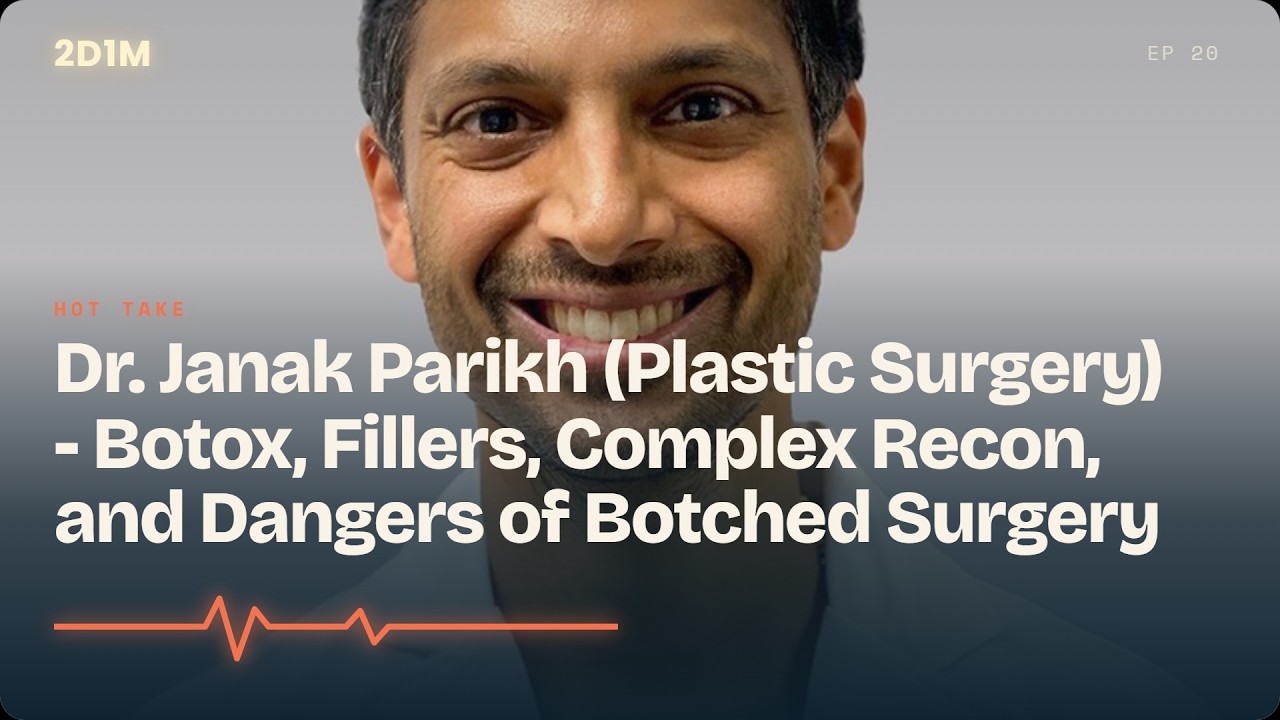
About this episode
The first 2Docs1Mic guest, plastic surgeon Dr. Janak Parikh, shares his unconventional path from general surgery and transplant/hepatobiliary surgery into a plastics fellowship during COVID. He breaks down Botox, hyaluronic acid fillers, Sculptra, fat grafting, facelifts and post-GLP-1 body contouring, and warns about botched surgery, filler vascular occlusion causing stroke or blindness, the unregulated 'cosmetic surgeon' board, med spas, and dangers of medical tourism to Mexico and Turkey, including paraffin wax and silicone injections.
What we cover in this episode
- Difference between a board-certified plastic surgeon and a cosmetic surgeon
- Botox for dynamic vs static wrinkles and preventive Botox myths
- Hyaluronic acid fillers, Sculptra and collagen stimulators
- Dangers of filler complications: stroke, blindness and tissue loss
- Risks of medical tourism and botched surgery abroad
- Body contouring and skin tightening after GLP-1 weight loss
- Fat grafting and facial volume loss from Ozempic face
- Setting patient expectations and body dysmorphic disorder in aesthetics
- PRP injections and laser treatment for hair loss
Full transcript
story together. So, we've met >> Yeah. uh a while ago for the first time. >> Oh wow. Since the monastery days, huh? >> And then now our kids are in the same school and they're in the same class, too. So, you know, we've known each other uh for a while. >> Yeah. What, like three, four years now. Yeah. >> And you have to you're going to be our first guest on this two docks. >> Awesome. Well, thanks so much for having me. It's >> Yeah. Yeah. It's awesome. >> Honor to be here. Yeah. >> Yeah.
It's great to have, you know, it's it's so far people have just been whoever is listening out there, you know, has been listening to just the two of us talk uh and give our views, but you know, we're limited. I mean, I'm a cardiologist. He's an orthopedic surgeon. So, we know about our fields and what we do and, you know, the perspectives we have, but it's always good to have other doctors come on and, you know, you're our first guest.
Hopefully, we'll have more guests in the future, but >> yeah, my my brain is totally maxed out. I have nothing else to contribute. So, I'm glad to have [laughter] >> Glad to have you on, John. >> Think of bones. That's all you got to think of. >> Yeah. Yeah, dude. Bone broke, me fix, and we've already talked about that. So, >> well, no, we we work with orthopedic surgeons, too. myself. >> Right. Right. But let's uh let's just talk about that. Janna, tell us a little bit about your background.
I think that'll be interesting. You know, as a plastic surgeon, and there's so many different ways that plastic surgeons can take their craft, but h how did start with just how you got to where you are. What was your path? >> Sure. You know, school and training. >> Yeah. So, my path was, you know, a little more convoluted than I would say most people. Um, and so, you know, there's kind of two tracks of going into plastic surgery.
The more traditional tract in this day and age is doing the what's called the integrated route, which is when you go to, you know, it's four years of undergrad, four years of medical school, and then you can match into a six-year straight plastics integrated program. And that's what a majority of kind of traineees are doing now.
Um, historically it's been what's called the kind of the now it's called the um, uh, the traditional tract or um, and so that would you would do general surgery for five years and then you would do plastics. It used to be two years of plastics but then they changed it to be three years of plastic surgery fellowship um to to match the integrated track when they started doing that. >> Gotcha.
And so and so um you know when I I did general surgery and when I was in training I never really had any exposure to plastic surgery u which is not that uncommon times you know you don't get that rotation or you know you just don't get exposure to it um and you know and that's true for a lot of I think medical specialties even in medical school I had no exposure to plast surgery so really didn't know anything about the field and when I finished general when I was finishing general surgery it kind of made came time to make the decision if I want to be you specialize in something.
I really didn't have any draw to plastic surgery because I didn't know anything about it. And so, um, you know, a good friend of mine actually, we were kind of in the same boat and he chose to do plastic surgery, um, because he didn't like anything else in general surgery, you know, um, but I wasn't bold enough to make that kind of choice. And so, um, I ended up doing, uh, kind of transplant compatibilary.
So I actually uh did a transplant fellowship uh in liver kidney and pancreas transplant and then I did a f a second fellowship in um hpatabiliary surgery. And >> how long was that after general surgery? >> Two years. >> So I did you know I did a year of transplant and and a year of um hpatabilary. And so after that I took a job I was up in um kind of outside of Detroit in Michigan um doing a combination of general surgery and habitatility surgery.
Um, and so I did that for, you know, close to seven years, six and a half, seven years. Um, before >> Wow, that's a long time. Before you decided, >> before I decided to come back. Yep. >> Oh, man. How did you like that? The doing the transplant surgery and stuff. >> So, you know, in my practice, I never did transplant. I ended up just doing more hippatabiliary and and general surgery.
Uh, and so I did a lot of um abdominal wall reconstruction, which is kind of dovetales into plastics a little bit. >> Right. Right. You know, historically it's been kind of plasty, but more recently it's been taken over by general surgeons and I I really enjoyed that.
I really liked the patients really had good outcomes and they were really thankful and happy, you know, and you know, compatibility is great, but you know, you're dealing mostly with cancers and mostly a lot of not so great cancers and survival with even with the best surgery is not, you know, not amazing. So, um, and and I actually have the fortune of having two really good friends of mine who are both plast surgeons.
And so, you know, literally it's like you would talk to your friends on your drive home. Hey, what did you do today? And like, you know, as you talk to them more like that sounds pretty interesting, you know, that sounds kind of fun, you know. So, >> um, so that's what kind of started uh kind of my thought process and wanting to do it. Um, and so >> two years into practice, I actually started two to three years into practice, I I kind of entertained the idea.
Um but then I shut it down for I was like this is crazy to go back to training you know especially three years of fellowship because you know and so I didn't really I kind of um backtabled it but then it kind of kept coming up you know of like well you know this is still an interest or this is something that I kind of want to do and it got to the point where [clears throat] in uh 2018 it was like well if I don't do it now I'm not I mean I'm not going to do it right because you know my my first one was still an infant.
And um you know I still had a lot of years left in my career and so it just kind of made sense and so it was one of those you know if I don't do it I'm going to regret it and so I I I applied and fortunately >> I mean that's admirable man just to to pull the trigger and make that decision.
I mean that's a huge practice and lifestyle change to go back to training >> especially when you have kids right I mean that's so much harder like once you're when you're single or not married it's it's much easier to kind of make that change even then it's tough but especially when you have kids and you know you've been in your career for a while you've already trained for so long making career change well when it's a calling right it keeps calling you it keeps kind of in the back of your head you keep keep thinking about it that's something you have to pursue right that's a big lesson in life too that you know the One thing you don't want is regret.
>> I 100%. That's kind of how I live my life. You don't want to have any regrets. You know, if I applied and didn't match and I would be doing general surgery today and it would it would be fine and you know, I would be like at least I can say, "Hey, I tried, you know." >> Yeah. You went for it. Yeah. >> And then, you know, but like Yeah. But I'm super happy. I'm I'm so glad it all worked out and I managed. >> So, dude, how how was like how was the application process and interviews and stuff?
I mean you you you know you were probably more experienced than maybe some of the attendings interviewing you you know just >> so it was actually kind of interesting.
Um so um you know there's some programs so okay so I ended up getting interviews at pretty high level programs right um >> but then some programs in that same category didn't even give me an interview right and then I think it's because and when I was going to these interviews you know their question always was well how are you going to be trainable you've already been attending like how are you going to take direction again and be a resident right >> and so I think some programs at least that I interviewed that they were intrigued enough to at least bring you in and see what you had to say in other programs right now this guy is not going to be trainable and so I think I had that dichotomy in my application um but you know I think when I talk to people and you know I tell them like yeah I'm committed to doing this I mean you know >> yeah when you when you went in and got in were you trainable >> you know what were the struggles like in the beginning like you know back going back from uh doing being an attending doing you know hipatility surgery and now going into plastics fellowship.
Were you trainable? Like how how did you take that uh you know initial shock to your finances and your and your and your ego? >> Yeah. So I mean the ego was not an issue for me. Um part partly because I had already decided, right? I had decided I was going to commit to doing this and so I knew what was at stake or what was required to to do it, right? Um the the the two issue the the financial part was the hardest, right?
And it's not like it's not like my lifestyle was that exaggerated, but I mean it's still a big difference, right? >> Massive difference. Yeah. Yeah. >> Massive. Yeah. I mean, you know, so we went from living in a house to living in an apartment. I mean this all happened during COVID. It was like not the easiest thing, you know. Um >> that's a lot to juggle at one time, dude. An infant, you know, CO is happening. >> Well, and then and then my wife was pregnant with our second.
So, literally like, you know, five months into fellowship, you know, or residency, you know, we had our second child.
So um you know um so you know that was that was probably the hardest part and then and then also not owning your time as you guys know and the best part about being an attending I think is that you control your own time um more than anything else and you know obviously when you're a resident you're on someone else's time >> right >> so those are those are the challenges more than more than the learning and then >> you know plastics is so different >> like did people uh you know treat you differently when you started like you know since you had been attending were attendings are a little bit more lax with you or let give you more freedom compared to other other residents that were much younger.
Not not not particularly. Um you know one you know so you know the place I trained at we all we were all the same. We're all general surgery trained and so they were used to having people who are kind of fully trained if you will right. Um but plastics is very different. I think people you know and other specialists don't necessarily understand like you know how they handle tissue and what they all their principles are so different than general surgery.
It's like it's almost like learning all over again you know.
And then you have like hand surgery which is like completely like different like there's you know you're like a you're like a medical student trying to learn that again you know because you have no exposure to it in my my training right >> um was different but >> you know so so there were some challenges like that I mean I think you know the first six months you just felt like an idiot you know you went from like knowing everything to knowing nothing.
Um, and so the first six months, I mean, I I literally had to like, you know, study hard, right, to try to just kind of catch [clears throat] up, if you will. >> And, you know, that's a that's a very good point because like, you know, it's people who aren't familiar like they think surgery is just all surgery is surgery, but it is so different like orthopedics, which is what I do, but I I do hand surgery, right?
So, even within ortho versus hand is like they're are completely different fields even though the bones are involved, right? And same with what you're saying, the tissue handling, the ability to raise a flap and all that stuff. I mean, that is very specific and very different compared to standard general surgery training, which is what your background was. So, it's a complete gear shift. >> Yeah.
>> It's always, you know, the kind of the running joke is, you know, you have when you have, you know, you're trying to you have general surgery hands, you know, when you walk and you and you start and you want to, you know, leave with plastics hands, right? Because, right, and it's very true how general surgeons handle tissue and it's just from our training, right?
I mean it because the general surgery training is more trauma based and so obviously you know if you're trying to save someone's life you're not really worried about am I pulling too hard on this tissue or whatever right like >> you know yeah you know is the incision a little crooked no you're not care you don't care this person's dying right so >> the situation is different but then but then I think that training or that mantra then you know proliferates all your training sometimes though >> yeah let me ask you this h how did your wife um take it in terms of just family dynamics right It's a big almost it's I wouldn't want to say a step backwards, but it's a change, right, financially, lifestyle-wise and stuff.
It probably took a huge amount of support from her, too, to make the decision, I'm sure. >> Yeah. No, absolutely. Yeah. No, she was supportive all the way. And yeah, I mean, couldn't have couldn't have happened without that support. So, >> no, that's huge. >> Yeah, >> that's really cool. I mean, very very non-traditional path, which I think is awesome. >> Very Yeah, >> that gives you that edge, right?
I mean you know that uh you have a different perspective on plastic surgery and and and those skills as well to kind of you know adapt as well be flexible when you come come and do surgery. So I know uh now you're done with training and uh now you're working and you have a plastics practice and you're doing all kinds of stuff. So I know tell us a little about the types of uh things you're doing because I know you're doing two different types of plastic surgery.
you're doing the one, you know, uh the one that we see in the movies and, you know, Niptac or whatever, the the the cosmetic side of plastic surgery, but then you you're also doing a lot of uh insurance-based uh uh like, you know, trauma related or burns or reconstruction stuff as well. So, tell us a little about that. >> Yeah. So, yeah, exactly. My practice is you know, half reconstruction and half kind of aesthetics or cosmetic surgery. uh you know very different on the reconstructive side.
Probably the two most common things we do are kind of hand surgery mostly hand trauma uh you know or infection um and then breast reconstruction or breast cancer. Uh so those are the those are the most common but you know I think um reconstruction you know kind of runs the gamut. Um you know we work with orthopedic surgeons to do some reconstruction. We work with neurosurgeons to do reconstruction.
So, um, you know, wherever there's any soft tissue loss, you know, um, or there's critical structures like bone or hardware that need to be covered, um, as a result of that soft tissue loss, that's kind of where we come in. So, you know, I do like that part of plastic surgery. You interface with a lot of different specialties. You're not siloed like a lot of other specialties are, you know, um, and and so it's nice. You have a lot of colleagues.
Um and and you know you learn from you learn from their perspective too because you know kind of like what Adele was saying you know every every it's every surgery is so different and so you know what I worry about when I'm covering something and what the orthopedic surgeons worried about I think you have to consider both those things to get the best possible outcome right >> yeah I mean I would say like for me the surgical service I work with the most by far is plastics I I do a lot of combined cases like a lot of brachio plexus cases big soft tissue defects post-traumatic wounds and things like that.
I I operate with the plastics guys a lot and those are actually really fun cases, you know, planning them and like you're saying, hearing the different perspectives, you know, like I'm thinking very much bone and joint recon and then functionality versus aesthetics, how the tissue is going to look, the different types of tissue that will move, will not move. Uh it it's very fascinating. I love doing those cases combined. >> Yeah. Yeah. So, I really I enjoy that.
I mean, you know, in general surgery, you don't again same you're you're a little bit more siloed and into your own into your own field, right? >> Um but here we interface with everybody which is really nice. >> So what percentage would you say of your practice is that it is you know kind of cosmetic uh plastic surgery stuff and how much of it is reconstruction? Uh and how much how much of your practice is completely cashbased and how much of it is you're going through insuranceances?
What percentage would you say is is >> Yeah.
So, you know, so my my I do my recon re uh I do my reconstruction at the county and so there it's kind of you're salaried and you know they you know you're dealing with a lot of uninsured or um underinsured patients um and so there you're salaried and you you know you whatever you're you just do what you do and that's kind of it right I would say that's probably like you know initially it was more 50/50 now it's probably you know I'm probably there like do you know 40% versus 60% doing aesthetics Um and so um and so yeah, so 60% of my practice is probably cash pay and about 40% is um uh kind of insurance-based.
>> Now I'm curious, right? I mean this is we we Adel and I both practice he he works uh at Baylor and you know I have a private practice and most of our stuff that we both see is insurance based. We do not do much cashbased uh >> um consults or treatments, you know. Yeah, some patients who don't have insurance need to pay cash mainly to get uh clearance for plastic surgery that they're paying completely cash for uh >> that's what they're saving. That's what their HSA is going to.
[laughter] >> Of course, like you know sometimes it's frustrating like you know the patients come in and they're they're getting a BBL or uh you know a nose nose lift or nose job and then um I'm like okay I think we need to do an echo because of your risk factors. and they're like, "Oh, I don't know if that that that's too much money." [laughter] And I'm like, "Really?" >> Yeah. >> Yeah. >> So, how is that dealing with like, you know, what kind of um uh what kind of patient dynamic is that?
Is that is is it more of a transactional um uh relationship with a patient when someone is coming in paying you cash to do a job versus you know in in your job at county where you're u you know really doing patients uh service I'm I'm just trying to see where is there is there more transactional relationship in that case when someone's directly paying you to do something for them how is that you know dynamic >> so for me you know, that dynamic is, you know, honestly very similar.
Um, because, you know, they're the patients in the aesthetic world are coming in because they aren't happy with something, right? Some part of their, you know, body or appearance or whatnot. And so, it's my job really to educate them on, well, what are your options? What and kind of what are your what what does that all entail and what are the risks associated with that? And what's the downtime and what's the cost?
and you know how are you going to put all this together to decide what's the best treatment for you at this point in time right so it's not dissimilar to kind of what we would do like when I see a breast reconstruction patient in in in you know in clinic it's the same discussion okay well these are your breast reconstruction options these are the pros and cons of each option you know and then kind of go from there I think in the aesthetic space obviously you know um the the ex the kind of the expectation of service is higher right so you have to be more available to your patients So, uh, you know, I think that's an issue.
I think there are some you do have to be careful. It's a very slippery slope like you kind of were alluding to that if someone's paying you, you kind of may do something that you may I mean, I wouldn't say it's wrong, but like you may kind of push the boundary a little bit, right? Like for example, if I see a patient and I'm, you know, and I feel like I can't really help them, I'm going to tell them like, well, I can't help you.
you can, you know, either your, you know, your aesthetic problem is either too complicated for me or your aesthetic problem is not significant enough for me to make an actual difference. But on those patients, it's very easy for me to also say, I just operate on you because you're paying me cash, right? So that's kind of an individual surgeon um, you know, decision.
You know, I can't sleep at night if I'm going to tell someone that I can do something that's going to make them, you know, that's going to help them, then I can't do it, right? Uh the biggest the other big difference in aesthetic surgery is patient expectation, right? You got to set the expectation. That is like the entire thing and you have to make sure the patient is on the same page as you are. Sometimes that's a challenge to figure that out or to to get that.
And sometimes you think you're on the same page and then only after surgery you realize, well, maybe we weren't on the same page, right? Um and so if you want to have happy patients in aesthetic surgery, that's really you have to understand kind of what they want. You have to make sure you're on the same page and then you have to make sure they trust you to get them through any issues that you're going to come up with.
>> And so, >> man, that that's, you know, it's interesting like I don't do any aesthetics or cosmetics in orthopedics, but even in our stuff, I mean, setting those expectations is so important. And you can I think it's honestly like one of the most challenging parts of the clinical encounter with the patient is discussing and laying out the expectations is just so that patients know what the whole journey is going to be like up to surgery through surgery and the recovery afterwards.
And so often man I think like oh man I I think I've done a good job like this patient gets it. I'll like draw on the little sheet on the exam table what it's going to look like give them these posttop protocols everything. They're like but why am I still stiff? I'm like dude it's been like 3 weeks. Like come on. You said an elbow replacement.
of course you're going to understand but it's just like you know what we say we give them so much info right in a short amount of time and what they grasp is sometimes very different um I can only imagine I actually I can't even imagine in the aesthetic world where so much of it is perception it's not like objective how patients could really easily misconstrue or they think they're coming in they're going to come out looking like one thing and you know I I can only imagine how difficult that is.
>> Yeah. Well, the other dynamic I want to kind of add on to that is, you know, there are some patients that are maybe one-off patients that they do, you know, oneoff aesthetic procedure because they're not happy with the certain part of the body, the nose, the eyelids, the the lower cheek.
But some patients, you know, they they get some kind of aesthetic s procedure or plastic surgery procedure every other year and they have these things where they're they're never satisfied or never happy, right? Um and and it is is very important to recognize that patient early on as well. Hey, is this the patient that has already gone through so many procedures and they're still not happy with that?
H how is that dynamic also that comes into play where you know you you're setting expectations but you know that this patient may never be satisfied. >> Yeah. And so again that's that's a actually a great point. I think um you know again individual surgeon that's where kind of sometimes surgeons egos come into play. Like I think like if I see a patient that's had three operations and they're not happy, like I don't think I'm going to make them happy, right?
And I would tell them that like I think that you know what you're looking for I can't deliver. And I've told people that I've seen and I've had people who come with very minor kind of you know what what they I mean for them it's not minor. I'm not downplaying it but I mean when you look at it when I look at it I don't see that as a big difference. And so I'm like, well, if it's a if it looks minor to me, it's really hard for me to improve that, right, to any meaningful extent.
And so, um, so yeah, I think, you know, again, you know, you have to be honest and that's where it comes in where like, okay, you know, we're still clinicians, we're still physicians. Yes, there's money involved, but that's when you have to have your kind of your own ethics and your own kind of morals to like what you're going to do, right? Because and again, that patient that you just mentioned, they will find someone to operate on them a fourth or fifth time. They will find that. >> Sure.
Right. And the other thing is you have to realize like I mean do you want to deal with that headache, right? Because you know they're going to not be happy. They're going to want a revision for free. Like you know all the all the baggage that comes with that. I mean you know you kind of you >> that's an interesting thing you just mentioned. [clears throat] >> Let's say you know you have an honest discussion whatever you and the patient are on the same page.
They they have a blroplasty or or rhinoplasty or something and then afterwards they're just not happy with it. They're like oh I thought it was going to be blank. I hate it. Whatever. >> Is that a common thing in the aesthetics world to do like a redo or revision surgery free of charge if a patient's unsatisfied? >> Yeah. So, I would say in my practice, you know, if if I think what they're unsatisfied with is reasonable, right?
If I think it's reasonable or if I think I can improve it, you know, I will at least wave my fee for the revision. Obviously, they have to pay for anesthesia facility, that sort of thing, right?
But um if I feel like you know like I did exactly what we talked about doing and that's the best you know outcome that you're going to get from that then then no I wouldn't offer them a revision just to have that right it's like like a like a common example I have for that is like let's say you have a patient who has a little bit higher BMI and you do lipo suction on right and if they're not h I mean and you made a meaningful change right but they're not happy because they still just have a lot of atyposity left well I mean I'm not going to re do a revision you just because they just want to redo life like more stuff taken out, right?
>> Yeah. Yeah. >> So, I think so so so you know that's kind of how I that's kind of how I deal with those things. >> Gotcha. >> Is that [clears throat] part of your discussion and you know um training throughout your plastic surgery training of where the limit is, right? I mean, where h how do you put those um selfch check-ins or or stops in your practice?
Because it's very easy for an aesthetic practice, a cashbased practice to just keep going and keep pushing the boundary >> and and and human nature internally is something that can get attracted to money really easily, right? >> Yeah. >> How how is that uh built into your [clears throat] training of where to put that full stop?
Cuz for example for me like or at like we have insurance sometimes uh you know uh stopping things that we could do like I mean we have our ethics as well and we have our morals and we wouldn't want to do the same uh procedure same echo every every month or uh stress test every six months for a patient because we know that could be harmful effects of that. Uh but insurance also comes in and and puts a stop to it.
But is that a discussion you guys commonly have in within your training of where to stop and when not to do something? >> Yeah, >> insurance insurance is our undesired hall monitor. That's [laughter] that's what insurance is. >> Well, I can tell you about Yeah.
I mean, I can tell you I can talk about insurance based stuff too in terms of like ethics and that sort of thing, but um just from my general surgery days, but like um you know um in our from a training standpoint, you get trained for a couple things, right? you get trained to kind of recognize what's called body dysmorphic disorder, right? Those are the patients like you said that are never satisfied.
You kind of want like stuff done like usually it's like minor things that are a big deal to them that you know to try to identify those patients. So that's one.
Um we do talk about kind of the kind of ethical approaches to like cosmetic surgery you know um you know if someone again it's it's also like okay another example is let's say you have a woman that comes in and you know she wants breast implants that are just way out of proportion to her body right um and so again she'll find someone who will do that but that's your work walking around too right if it looks ridiculous then I mean yes she may be happy with that and that's something she wants but again do you want that patient to kind of be advertising you that way, right?
>> Yeah. It's your reputation. Yeah. >> And so if you look at plastic surgeons, I mean, you know, there are certain personalities that will attract certain types of patients >> and it kind of just shapes your practice that way, >> right? Um because if you do one of those patients, you'll get more of those patients, right? Um because again, that's kind of that's your look and that's what you do, right?
Um so that it so that you know those are some of the nuances in kind of the aesthetic in the aesthetic world. And then one one question Janik about like training in particular. You know from my understanding like again working with plastic surgery residents throughout my residency and now um as an attending a lot of training is more so biased towards the recon side. Correct.
Like the pure aesthetic cosmetic side that's almost you have to seek out a subsequent uh fellowship afterwards more in the pure aesthetic space. Isn't that true? >> That's that's generally true. Um, you know, I trained a Methodist and you know, we had a very robust, you know, our attendees had a very robust aesthetics practice >> and that was one reason I picked that program that they had a good combination of aesthetics plus reconstruction. >> Gotcha. Gotcha.
>> You know, so I got a significant amount of aesthetics exposure in kind of my training more so than most people would I would say. Um, but you're absolutely right. I think if you know if you go to a very highpowered academic program, it's going to be mostly reconstruction. Having said that, you know, everything we do in aesthetic surgery is based in reconstruction. So it's the same techniques just applied differently. >> Right. Right. I got you.
>> And so even when So I think sometimes, you know, in the media and not the media, but just like, you know, online social media and stuff, people kind of say, oh, you know, this guy, you know, I'm a cosmetic surgeon and that person's a reconstructive surgeon. They can't do cosmetics. Like that's not really true, right? They have all the training and and technically they can do all those operations. >> Right. Right.
You know, that that's another thing, you know, like this whole like field of cosmetic surgeons, right? Because a lot of people like with billboards that advertise as a cosmetic surgeon, they're they're not actually plastic surgeons, right? A lot of them >> never did a PLA a formal plastic surgery training. It's Is that true? Like that that's what I've heard as well. >> That is correct. Yeah, it's it's somewhat misleading.
Um, so there's a, you know, they basically created a what's called a board of cosmetic surgery, which is not really a board because it's not recognized by the American board of of medical specialties. >> Okay. >> It's not a it's not a true board, but they created >> they created their own club, >> right? Basically and so they and they created their own fellowship. So they, you know, they do it's a one-year fellowship.
So basically after you do any surgical specialty, so after you do either OBGYn, general surgery, orthopedics, neurosurgery, any surgical specialty, you can do a one-year training in a in cosmetic surgery and call yourself a cosmetic surgeon. >> Oh my gosh, I'm about to be a cosmetic bone surgeon. [laughter] >> Yeah. >> Sign me up. >> You know, and so that's Yeah, that's what And then, you know, um you know, it it's it's it's so it's to the point.
It's so been so it's now so pervasive that like board certified plastic surgeons are are just getting the cosmetic surgery board as well. >> Really? >> Yeah. Because like that way they can say I'm like whatever board in cosmetic surgery even though it's >> oh >> complete invalid if you will, right? So um but because of just a perception out there, >> you know, >> what are some procedures? How would you differentiate a plastics?
like what you know I'm I'm guessing the cosmetic surgery fellowship has a limited amount of procedures that they're focused on whereas the plastic surgeon has has a much more wide array of things they could do. So what are some things that a plastic surgeon is better trained to do versus that cosmetic surgery fellowship? What are some types of pro procedures that you can differentiate with? >> Well, I think there's a variety of cosmetic surgery kind of fellowships, right?
Um some are a little bit heavier in face and some are heavier in breast and body. Um, I think all the plastic surgery based cosmetic surgery fellowships are probably, I would say, um, more well-rounded to kind of give you exposure to face, breast, and body.
Um, you know, um, facial plastics, there's, you know, ENT has a has a route to do facial plastic surgery and so they'll do ENT and then do a facial plastic surgery fellowship and that's all just face, you know, face lift, brow lift, cleft, all that sort of stuff.
you know the ocular plastics guys have you know or or I should say opthalmology has ocular plastics so they do all the per you know it's like aesthetic surgery of the of the eyelids and and the brow and all that so um you know there's a lot of overlap um um you know uh I would say I feel like I feel like a lot yeah a lot of the a lot of the guys who doing the cosmetic surgery fellowship know if you're general surgery or orthopedics you're usually doing body work because I think the body work is a little bit more straightforward the face is more complicated.
>> It's less forgiving. >> It's less forgiving. >> So, do plastic surgeons uh are when people are seeking out plastic surgeons, do and they want want to get a cosmetic procedure done, are there certain plastic surgeons that are are they market themselves as mainly focused on the face versus some on the abdomen or the hips or or the breast. Just like in orthopedics and you know there's hand surgeons and and [clears throat] you know people who do hip replacements or people who do shoulders.
Is that the same kind of thing in in plastic surgery as well? >> It is um you know I think especially in larger markets um people kind of develop a niche so that they can actually stand out you know because if you say you do everything well everyone else is everything too so what makes you better than everybody else? But then if you say, "Hey, I just do, you know, breast," then, oh, you're like the breast expert, right? So that's kind of how people try to stand out.
Sometimes it's driven by your your your own your own um I mean, part of it's driven by your own kind of what you like to do, right? And I think part of it driven by kind of what type of patients you're seeing and what you're doing a lot of. Like for example, like for whatever reason, let's say if I start seeing a lot of facelift patients, well, my practice is going to kind of gravitate towards doing that.
And now I'm going to get known for doing that because you do one facelift that's good and it's good. You're going to do get another one you know I mean it just kind of stacks right. >> Yeah. Yeah. >> And so the practice kind of makes itself if you will as long as you like doing facelifts you know but if you say I'm not doing those then you know >> dude that that's so true because like sometimes it's like the procedures that you really don't want to do.
You do a couple of them and you become known as like the guy in town that'll do it. Like I for example like I do a surgery a scapular thoracic fusion where you're fusing the scapula the shoulder blade to the ribs on the thorax for like very bad posttumor reconstruction or scapthoracic instability. That case sucks. It's like really hard. It takes a long time. It's very high risk but like no one else in uses. I've just dude I get referred way more than I ever wanted to [laughter] do. >> Yeah.
People coming in out of town to see you. Yeah. >> I know, man. But I could totally when you just said that that's what it made me think of. I was like, "Oh my god, I just saw a patient in clinic today who has had like a non-union of the prior scapular thoracic fusion. Someone else did." I was like, "Oh my god, I have to revise this." >> Oh, you do? Yeah. >> But like that's that happens for sure. It's like you start getting this cycle of patients and like you never even intended it.
It just happens. That's your your practice just grows like that. >> Yeah. >> Well, and then then like everything else in surgery, right? You know, you do more volume so you get better at it so your outcomes get better. It's like just feeds into itself, right? can't stop the [clears throat] train after a while. >> Yeah. [laughter] All aboard.
>> So, one thing I really wanted to get into uh uh in in this discussion was, you know, we've talked about the rise of uh the wellness medicine or longevity medicine and all these these new trends that have come up and you know we've done episodes on GLP1s, we've done episodes on peptides. Uh what kind of effect do GLP1s are having on your practice in plastic surgery? you know, there's a lot of patients that are losing a lot of weight.
Um, you know, so maybe the demand for some of the the the procedures for for this the loose skin or you know, lipuction [clears throat] probably are changing, right? The demands are changing and and maybe even there's more demand for it now. >> Yeah. So the demand Yeah, I mean agreed. So the dem demand is changing. Um, you know, I think it's changing with the demographic shift.
you know, younger patients are seeking procedures, uh, especially, you know, because of the GLP ones, they've lost weight. Um, so couple of things just kind of going from top to bottom. You know, you see a lot of people who have a lot of volume loss in their face. So, they look hollowed, they looked aged. So, if you once you lose volume in your face, you age pretty fast, >> right? >> Yeah. Exactly. And so, um, you see a lot of that. Um, and so, um, so that's one one issue.
Then the loose skin issue. So skin tightening >> just just kind of elaborate on that a little bit. What are you guys doing for that? That's that's a big topic and a big discussion and big you know a lot of people are discussing the ompic phase or the weight the phase they get after weight loss where they're you know everything kind of sinks in. So tell us what kind of procedures are there around that people can seek out when they've lost that much weight.
>> Yeah so you know I mean every indivi every case is kind of different obviously but in in general the concept is you know we want to use fat grafting. So fat grafting is where you'll take do lipo suction on one part of the body to harvest or take the fat and then we'll process it and inject it into the face to restore that volume you've lost. And so um and then in addition if people have kind of loose skin there are some things you can do for skin tightening.
Now some things um you would do you know you can do for skin tightening if you have kind of mild to moderate laxity but if you have a lot of laxity then you need to do surgery which should be like a facelift right a facelift or a neck lift um where you're actually cutting out the extra skin um so from a from a so from a facial rejuvenation standpoint that's kind of kind of what we do um you know on the body again like I said there's you know you can for some patients you can do just some skin tightening procedures um those involve involve usually some form or fashion of heating the skin and call causing contraction of the collagen um to tighten the skin.
Um and again, if you have a lot of loose skin, that's not going to work. And so, you're talking about doing surgery. So, the one thing I would say that's probably um becoming more common or more popular after the GLPS is what's called a circumferential or 360 abdom tummy tuck or abdominal plasty. So because they have kind of loose skin all the way around and so whereas before you can address most of that just from the front now you have to kind of go all the way around.
>> Dude, it's funny you mentioned the circumferential one. Um I operate on the same day as one of the plastics guys and he at least he does. I don't know if you're in the He hates doing that because he has to do position flip in the O. Oh yeah. >> Which like it it lengthens the surgical day so much. I mean, he's like walking down the halls cussing during the position flip. He's like, "I hate doing this." [laughter] >> Flipping. Yeah.
It just adds more time, you know, and then if you have any airway issues, it's like a pain in the butt to >> Man, I know it. >> Yeah. [laughter] >> As much as you can not prone them, it's good. >> Yeah. No kidding, dude. >> Yeah, I can imagine.
I mean, you know, that that's it's a it's an interesting space and interesting time we're living in where now [clears throat] there's a lot of you you talked about the board of cosmetic surgery, but then there's a lot of um you know, this trend of med spas that's that's rising, right?
A lot of like every person I know, every other person I know is doing some kind of Botox uh you know uh fillers, sculptra, whatever types of different uh injectables or peptides uh for skin rejuvenation or or uh improvement in the you know uh I guess uh anti-aging procedures. Uh I want to see what's your take on that is as a as a plastic surgeon and what do you how do you feel first? I mean, you know, what should patients seek out and where should they seek care?
Um, you know, is are these med spas and someone who was just trained over a weekend or through a conference uh on these inject injectables uh appropriately trained to do these procedures and um kind of see from your perspective >> like the the online course from DVR University is that [laughter] is that adequate? >> Yeah. So um yeah, I mean this is a you know obviously a hot topic you know across our specialty and you know just across aesthetics in general.
I mean you know aesthetics is it's a large space. Um there's definitely a lot of specialty creep. Um and kind of as you mentioned a lot of people are doing it. So you know I think for patient from a patient standpoint it's really kind of seeking out this the person who's probably the best trained.
Um, and you know, there are great injectors and and practitioners out there who, you know, maybe are a nurse or a nurse practitioner or, you know, even a or primary care, whatever, some nonplastic surgery specialty, but they are well trained because they've done a lot of courses. They've, you know, done it for a long time and so their results are, you know, good results. They're safe. They're ethical.
Um you know but then on the flip side there are people out there yeah they do a weekend course and are doing all this stuff and you know their results are not that great you know and you know and they have more complications and so you know there's no policing the field in in a way right because >> you know you everyone can do this stuff right there's no regulation per se um and so it the onus is really now on the patient to decide how are they going to find the the provider that you know they think is a is kind of the best to the safest for them.
Um, you know, fortunately, a lot of the injectables and stuff, you know, have have relatively low complication rates. Problem is, you know, if you do have a filler complication, it can be devastating, right? Because you're talking about stroke, blindness, or tissue loss, and that's permanently disfiguring or permanently disabling, right?
So, I mean, uh, I think because the frequency of it so low, you know, a lot of people get away with doing things they probably shouldn't be doing or not trained adequately to do. My, from my perspective, I think if I was a a patient, um, I would want to go to someone who can handle the complication that may occur from what they're going to do, right?
And I think you know even like you know cosmetic surgeons and other people like that's not always true for them you know like if if like if you're an orthopedic surgeon you did a cosmetic surgery fellowship right and now you did a tummy tuck and now the patient has to get admitted to the hospital you know like if you know you have admitting privileges for ortho right and you you know you let's say they're not going to let you take that patient to the operating room to wash out a hematoma because you don't have privileges to do that because you're credentialed in orthopedic surgery.
So like you can't even take care of that patient and deal with your own complication, right? So I think again those are little nuances that you know no one really talks about. Patients don't really know about but you know when when it really happens you're essentially abandoning to the patient, right? And so um you know I think that's how I would want and I would want to pick someone who can at least handle all the consequences of what you're going to do to them. >> Dude, totally.
I mean I had a patient that was referred to me for something like that. There's this lady.
She was like in her 70s and um she went to a place like this like I don't I don't know if it was a med spa it was some wellness type holistically advertised place and they injected paraffin wax in her face and in her hands you know like she was an older lady so her hands had some standard age- related atrophy and the hands you become gone your metacarpal bones stick out >> and she you know wanted to have her hands look younger and so she had them injected in her face to fill up her cheeks and throughout her hands hands in the in the inner oius spaces and oh my gosh dude her face was I I felt so bad for her I I sent her to a plastic surgeon for the face and then you know I went in and removed I mean the paraffin wax was just like chunks of wax in her hand and it totally like killed her in her oius muscles and she had barely any finger motion it was horrible but that that's just an example that like I've seen it's like it's crazy that people in Houston some random clinic was injecting paraffin wax in this in this lady's face in her hands is absurd It it's crazy that this stuff happens in America in 2026, right?
Like I remember in my fellowship, right? So like you know the last couple years I saw a lady who um had silicone injected into her buttock, right? And we've long known that you don't do that like right like it's [laughter] been like decades we've known this. >> And I'm like what I said when I first met her like what country do you have done have this done? She goes Louisiana. >> I just I just assumed that it was in another country, right? that could be a different country, >> you know.
And then and then it turns out she went to some her friend had recommended someone who's doing this out of their garage. And I'm like, how do you think this is like good a good thing, right? >> You know, you got to have some amount of personal responsibility. I mean, if you're going to go to someone's garage and they're going to shoot you up with some random silicone in your butt. I mean, like, >> come on. >> Anything. >> Exactly. That's crazy. >> Yeah. >> Yeah.
But, you know, h how do you I mean, you know, there's a lot of patients I see uh you know, I do cardiac clearances for a lot of and a lot of patients are going to Mexico to get some stuff done as well and because it's much cheaper or you know, they're getting it done and and and the those practices just say, "Oh, get the clearance from your cardiologist." So, then then I'm here uh trying to get a you know, they need exercise tolerance test, they need an echo cardiogram, an EKG, and some labs.
And then I'm here and you know, I kind of want to counsel the patient. Hey, you're getting the surgery. like, you know, I know it's not my job to do that cuz I'm not doing the surgery.
But as as your physician, as a doctor who's seeing you, I do want to be able to kind of warn them or kind of, you know, uh, let them know because a lot of these practices are complete cash pay profit driven practices that are that are providing these services and a lot of them are sometimes not uh really the really uh, you know, putting the right safeguards in place to know when to stop and what what to inject, what not to inject. What are some things?
A lot of them are are mainly run by uh you know non-f physicians as well you know non-f physicians or primary care physicians or someone who's not [clears throat] highly trained to deal with the consequences right so um you know I I some of the things that I hear you know like you know this frequency of BBLs that are happening you know or or u preventative Botox or you know non-stop fillers or people are going weekly and getting fillers.
Um, sometimes I wonder is, you know, this in this profit-driven space, how do you how do I, as a physician who's taking care of these patients, counsel them and and warn them because I don't even know much about these these things and, you know, who can we talk to? >> I mean, I so I think [clears throat] medical tourism, you know, living in Houston, we see a lot of it, right? We see all the complications. I see them at the county hospital. I saw them when I was training at Methodist.
I mean, you you see them, right? Probably probably a couple times a month. Um, and a lot of those complications are pretty devastating. You know, permanently they're permanently disfiguring. Um, and so, um, yeah, it's a huge problem. Um, you know, I think it's I mean, I'm glad you're at least mentioning to them that you're concerned about that.
I mean, you know, I think I always tell people like, look, you're going to go somewhere to get surgery and then you're going to leave that place and like the you have no followup. You know, what happens if some something happens to you? What are you going to do? Right?
Um and so you know but but that's all you can do is tell them because the desire to get it done and you know there are a lot of people who desire aesthetic surgery right the limiting factor is the money and so when you can get what you want for cheaper that that drive is so strong you kind of reason just goes out the window right you just kind of tell yourself everything's going to be just fine and they probably have some friend that had it done and everything was fine for them and so they think oh yeah it's no problem right but they don't really think through the steps of like well what if they They don't plan for the what if and then if when the what if happens it's devastating for them both financially because a lot of people don't also don't have health insurance.
So it's financially devastating as well as you know um physically devastating. >> Yeah. I mean when when a patient is undergoing a surgery they've already decided in their mind that they think it's going to help them you know like that's why they're choosing to do it. So they what you said is so spot on.
I mean they are not at all realistically thinking and preparing for the negative eventuality like the complication and like okay now what >> and they're not guided by that you know medical tourism hub in Mexico or Turkey right because those places are just like they're technicians I mean they're like little factories people show up they get the procedure and they piece out those places by design don't have any follow-up I mean they just they cut cut cut cut cut cut cut cut cut cut cut cut cut cut cut cut cut cut cut cut cut cut cut and then on to the next >> yeah so let's let's get into a little bit more specifics of uh you know I I keep hearing fillers, fillers, like what are fillers?
What what is that? Why are people getting it? And why everyone is doing it from from a nurse practitioner to a nurse to the primary care physicians? And most primary care physicians have completely switched their practice from being primary care to purely being a practice where they do fillers all day. >> So what what is why get it? Why should people not get it? What should they watch out for?
>> So in general, when people talk about fillers, they're talking about what's called hyaluronic acid fillers. So hyaluronic acid is a natural component in your body in your tissue and it basically provides volume to your tissues. And so what they do with the hyaluronic acid fillers because your in your body hyaluronic acid turns over every 24 hours. So what you do is they cross-link it which means they chemically bond it in a certain way to to affect the stiffness of the filler.
So you you know you can think about it as kind of a soft to all the way to a stiff filler because you're going to use those in different parts of the body. So, if you're going to, you know, inject into the lips, you're going to use a softer filler. If you're going to inject it into your midface, you're going to use a stiffer filler because you're trying to lift the tissue. Um, this so the more cross- linked the the filler, it'll also last longer.
So, for example, filler in the midface can last 12 to 18 months. Filler in the lips will last six months. Okay. So, some so um and you know, kind of the why you do it is because you're trying to volume restore or volume enhance, right? So, like I said, one of the first signs of aging is volume loss in the face. Um, and so by restoring that volume, you can kind of create youthful a youthful appearance.
Um, you know, it's kind of now going a little bit more out of style, but before the big lips were, you know, really popular and, you know, um, and so that's volume enhancement. It's like taking someone has normal kind of sized lips and you're adding more volume because you want them to be bigger. So, um, it's a tool for kind of volume enhancement, if you will, right? Um uh and so um you know there there are other kinds of fillers but that's kind of the most kind of common.
Um there are other fillers that will actually stimulate collagen um and and uh >> what are some of those?
Um so um Sculptra is is a is a collagen stimulator and so typically that requires you to do a series of them and then so basically so with the hyalonic with the hyaluronic acid filler as soon as you inject it you see the you see the result you see the volume enhancement with sculptra you inject it you initially see it because you actually put in sculpture mixed with saline right so you see the volume but then it goes away and you basically kind of almost look like you didn't do anything and Then after the ne after after you finish a series you actually see the volume changes because you've actually built up new collagen.
So um and then that lasts that's kind of permanent right once you build that new collagen that that lasts for a much longer time. >> When pat when patients are going to a lot of these aesthetic practices to get sculpture done or to get fillers done what are some things they should watch out for? What are some complications that could happen and um could anyone be trained to do that pretty easily? So I think um you know aesthetics is an is is is an art form right?
So like you know you you kind of do have to develop and and have an artistic eye for what you're doing and that is grounded on knowing the underlying anatomy right so understanding kind of the facial muscles where they where their origin is where their insertion is what their action is you know all of those factors kind of play into what kind of aesthetic result you're going to deliver for that patient. Um and so yes I mean you can you know anyone can be trained to do it.
Um but to do it well you have to have these other kind of components and you have to have more of an understanding right like I can show yeah inject here here and here when they have this when they come with this complaint but you know if you don't understand what's my end point of injection what is it what should it look like right what's the what's the natural contour in this area um you're not going to get the best result right >> uh from a complication standoint >> about opening a a preventive cardiology sculpture practice Yeah, [laughter] >> is going to start doing echoes and sculpture.
>> That's the goal. But you know, >> if you start doing that, you're going to stop doing echoes pretty soon. >> Yeah. No kidding. After one clinic. >> All right. >> So, I I have a question, John, about about Botox. Okay.
Like there's a lot of stuff especially like you know I think it's like very much like a marketing thing but maybe I'm incorrect with Botox about that you've got to start Botox super young as a preventive thing and do it for life because if you start it when you see wrinkle lines it's already too late you got to do it to prevent Is that legitimate? Is that true or is that just a ploy to get people to serely inject for longer? >> No. So I Okay.
So I think so it's not it's not true but I I'll I'll explain kind of what the kind of concept is right. >> Yeah. >> So so first of all when you kind of your your lines or your wrinkles on your face they come in kind of two fashions right? One are called dynamic. So like it's when you're expressing yourself. So like you know if you smile really big and you get the lines on the side of your eyes those are dynamic right but when you don't smile you don't have them.
So that's kind of the first and then they and then you have what are called static lines. And so as you age, some people will get the static lines. And so, you know, there are people who are very expressive and they do that same expression over and over again. And so then those lines will slowly become static. >> Okay? >> Botox will fix Botox will treat the the dynamic lines, right? Uh and they will soften the static lines, but they won't ease them. Okay? So that's kind of how Botox works.
>> Okay? Now, this concept of preventive Botox, I kind of liken it to this analogy. If if you started dyeing your hair before you had any grays, no one would ever know you dye your hair, even when you >> too late for me, bro. >> Yeah. [laughter] So, same thing, right? Preventive Botox, you start doing it when you don't really have wrinkles. I mean, then no one's ever know. You just keep doing it, right? And you and you look like you've never aged or you look like, oh, you're not doing anything.
Make sense? Yeah. >> So I think that's really that's really the mechanism of preventive Botox. Now >> um I I there is um I think >> at least from my experience there's a side benefit of Botox that people I think don't always talk about and that is actually it does improve your skin texture and quality. Um and I you know I just so so your skin just looks smoother. Even if you don't have a lot of wrinkles it your skin looks smoother. Um so you know I mean there's there is benefit of doing it.
Um, but no, there's preventive like I think that's it's more of that anal it's more analogous to what I was saying about the hair coloring in my mind at least. >> Gotcha. Gotcha. >> There's no there's no there's no physiologic basis of like oh if you do that if you paralyze a muscle longer you know you're going to delay aging. >> No that makes sense. I that's a good perspective the way you explained it that makes a lot of sense.
>> You know in terms of Botox and fillers can you doing too much can it be harmful for the skin and the facial muscles as well? Yeah, that's a great question. And so, um, Botox, I would say, is relatively safe. I mean, we, you know, we haven't seen, um, any kind of muscle atrophy or any of that of those kinds of things with repeated use, right? Um, what we, you know, sometimes you may need a little bit more in terms of units to get the same effect as you've kind of used more.
Rarely are we seeing people who um become kind of resistant to the Botox which means that you know you do do it and either they don't get the same effect or the duration of effect is shorter. Uh and in those cases just switching brands or you know can can um alleviate that issue. So we [clears throat] haven't really seen you know what you might think in theory could be some of the issues with Botox.
I think um with Botox or broadly speaking neurotoxins in general what you're what the issues are is um incorrect placement can lead to un you know um event you know things you don't want to have happen right the most common would be you can get eyelidtosis if you inject the forehead too low and it gets into your levators you know fortunately there's you know eye drops to to help kind of offset that if you will uh and then in three three months it's going to wear off, you know, and it always wears off and so you you know, you kind of return to baseline >> this idea of the filler staying within your under your skin and kind of spreading around and making your face structure change.
>> Yeah. So fillers [clears throat] is yeah very different, right? So filler um you know we think that they all dissolve and um in certain areas we now know that they really are almost permanent, right? Um there's actually paraffin wax paraffin wax. >> Yeah.
There was actually this great study done out of out of Canada where they did under eye filler and they took MRIs of people and like even 10 years later they showed that there was some residual filler there you know um and so um you know so so that's one issue. Second issue is like we talked about the vascular occlusion. That's probably the most um devastating complication, you know.
Um and that's what happens if you know if you don't know the anatomy and you get the inject the filler into a blood vessel, you can get a what's called an embolis. And that basically, you know, because the facial vessels are all all are all all branches of your corateed. And so when you retrograde have an embolis, it's going to go, you know, into your brain, give you a stroke or uh or olude the u you know, optic artery and give you a you know, make you blind.
And so and at the very least it'll give you tissue loss. It'll give you local eskeeia to to an area. And so uh again pretty rare complication again with the proper and knowledge of anatomy and technique you can I would say avoid it. You should be able to avoid almost all the time. Um [clears throat] and um but but you know obviously the most devastating. And then the other you know other parts of fillers is you can get some what are called nodules.
So sometimes you get inflammatory nodules, sometimes you get um nodules, those you know you get a low-grade infection that creates a little nodule. Um and so those can be sometimes difficult to to treat um as well.
Um so those are some of the issues I think you know more and more people I think are kind of getting filler what what's what's being termed filler fatigue and um you know kind of like what you were saying right that you're because they don't fully dissolve you're essentially stacking and building up filler and so then it's starting to change what your face looks like you know because it because once it's once you're like once it's just sitting there it's not behaving in the it doesn't have the same properties as as the actual filler, what it was designed for, if that makes sense.
Right. [clears throat] >> Let me ask you this. In terms of like gender differences, like what do you see in your practice on the cosmetic side? Like men versus women, you know, guys coming in versus girls coming in and like, you know, face-wise, what are the different stuff that guys usually want done versus girls? What men and women want done?
Yeah, that's a great uh so you know I think you know I mean even you know historically it's been mostly women right that's changing a little bit um obviously still even today it's mostly women that are coming in for procedures um but more guys are coming in it's more accepted which is good um from a facial aesthetic standpoint you know I would say the most common or the most popular for for men is kind of around the eyes what we call perorbital rejuvenation so upper eyelid bluffroplasty lower eyelid bluffroplasty um you oftentimes because you know in general men have their brow sits a little bit lower um and their their for their their frontal bone is a little bit more um forward and so they can look kind of tired and and and like heavy eyes a little bit more easily you know and so um I think that's what really that and then the other thing is the the neck especially now that we're on you know Zoom calls and stuff people see this contour a lot and so you know both men and women will come in for But you know now men are coming in for kind of doing something about the with the turkey neck or you know just that fullness in their neck.
So I would say those are probably the you know the most common or most most popular >> you see a lot of hair loss stuff because I've been say seeing um things like PRP injections and you know how much truth is that how how much evidence is there behind PRP injections into your hair follicles for hair growth and things like that? >> I mean so there is evidence for it. Um you know the question Just to clarify it for everyone, this plasma rich protein, right? >> Yeah. PL plate rich plasma.
>> PL rich plasma. Yeah. >> Yeah. PL >> and so um you know I mean there I mean they have like trials that show you know clear benefit of PRP. The the question always is is it more beneficial than finasteride, right? Like um and so that is I think somewhat debatable. Um, you have people who think PRP works great and you have other people that say PRP doesn't really do anything. Um, I think that, um, there's obviously differences.
If you think I think if you take the PRP of a 20-year-old versus a PRP of an 80-year-old, there's got to be differences in terms of just what you're getting, right? Um, and so that probably affects its efficacy as well. [clears throat] Um, I think hair is complicated in terms of for a few things. I think you got to have a multimodal approach to hair because um you know there are different mechanisms or different things that trigger hair growth.
Um and so I think having a multimmodal approach is probably the most makes the most sense. Um and then you know it's it's patience, right? You got to do it for a long time because [clears throat] hair growth is such a slow process um that you're not going to see a benefit for 6 to 9 months. And so, um, you know, kind of getting someone to commit to doing something and waiting that long to see progress is kind of hard.
Um, [clears throat] but, um, but yeah, I think I think there's, you know, there's definitely a lot of promising technologies.
um you know uh the most recent one is a FDA approved laser treatment uh that um [clears throat] has 25 shows you know 25% increase in hair growth um you know after a series of treatments which is about four to five treatments um which is pretty pretty pretty powerful and pretty exciting >> right that's just like a surface laser like you just expose it to this skin and the area to the laser huh >> yeah exactly >> yeah [clears throat] >> so you know I know we're getting quite a bit on time as well.
So, I did want to kind of ask your opinion on a couple of things. Um, what do you think is the most overrated uh aesthetic procedure and what is one of the most underrated uh aesthetic procedure in your view? >> So, I don't know if I would call classify them as overrated, underrated because these are very personal decisions for everyone and so you know what bothers one person doesn't bother another person.
You know, sometimes patients will come in and they'll say, "Oh, yeah, my eyes really bother me." And you look at them, you're like, "Well, you should be worried about this, this, and this." But obviously don't tell them that, but you know, so so it's very it's very individual, right? And so I I would reframe that question and say, well, what's the biggest bang for your buck, right? And so I think upper eyelid surgery, you know, and then liposuction of this area, the chin or the neck.
Um, and I say it's the biggest bang for your buck because it's relatively low downtime, pretty easy surgery under a local anesthetic, right? Um, pretty reasonable cost, but the effect is really good. Like it makes a huge difference in your appearance, right? So, [clears throat] um, so I think those are those are two, at least on the face, those are two procedures that are I think, you know, kind of really good bang for your buck. Um, you know, I think lipo suction can be amazing for some people.
Um, it just depends on kind of, you know, it's great for people who are actually in shape and have a little bit that they can't lose because you can just contour that, right? So, I think lipo suction is another one for at least for the body that like potentially could have a lot of, you know, bang for your buck, if you will. A little more downtime, a little more involved, but in terms of effect, you know, you get a pretty good effect.
Um, so but but yeah, I don't I wouldn't say anything is overrated, you know. I think it just, you know, kind of individual uh the balance between how much it bothers you and are you willing to have the downtime, right? Um kind of that's that's the that's the formula. >> Yeah. And I guess I I asked the question the wrong way, but I was kind of trying to tease out the, you know, the trend versus uh something that's evidencebacked or, you know, uh timebacked.
You know, we see in cardiology, we're seeing a lot of different things that wellness, longevity, and a lot of things do not just have evidence behind it. We had we did a whole episode on peptides last month, and there's a lot of things. It's hard to kind of endorse that right now because hey, >> dude, loves peptides. That's basically what it was. >> Huh. [laughter] >> Yeah. But but there's a lot of things that it's hard to endorse that because there's not much evidence behind that yet.
But people are going and and seeking it, right? And it's become a trend and a lot of people are selling it. What is something like that in plastic surgery that's become a trend is it's it's very popular. People are seeking it, but it's not we're not sure if it's very effective or not. >> So, um I mean I would say at least in the in the plastic world, it's all of the things you just mentioned. It's all the more on the wellness side, right? Um you know, I I'm kind of like you.
I really like the wellness space. I think there's a lot of potential there. I do think that it's being oversold at this point. I actually went in December went to the um A4M which is like the biggest anti-aging kind of conference and I was a little disappointed because you know there the the claims they're making are are bigger than the data right at this point.
Um I I would say I think that there is some promise but telling someone you take this peptide and it's going to do all these amazing things to you is wrong because we don't have the evidence to back that. telling them, hey, take this peptide. It may do these things for you and, you know, it probably won't do anything bad to you. I think put framing it that way is better, right?
Um because I do think that, you know, some of these things do have efficacy, you know, and we might not be able to measure it yet. We might not be able to measure on a population level, right? Um some of these things might be individual, right? So, you know, if Adil takes one peptide, he may feel nothing and you take it and you feel great and and it's and it's, you know, and I think that can that can that can be true.
Um, but to just kind of get up on a on, you know, get up there and be like, "Yeah, this is going to like cure all your problems." And that's wrong. So, >> yeah, there there's a lot of there's a lot of big big talk >> these guys on the podium for sure. But I mean like dude I I have so many patients that take peptides and it's that number has grown in the last year year and a half and I mean like again and again and again anecdotally these patients swear by it.
I mean and they're so aware of their cycling the peptides. They know the dosing. They're injecting it appropriately and like I haven't seen any direct negative effects of it. That that doesn't mean that I'm going to start prescribing it but >> like I I have been very pleasantly surprised. Yeah. Yeah. I mean the this conversation we can keep going on and on but you know we got to put an end to it at some point but you know it was it was uh a lot of uh interesting stuff.
I think uh you know I learned a lot. I hope uh you know the few people who watch us uh learn a lot. [laughter] So >> it's always fun. >> Yeah. Yeah. No, this was great man. It was awesome to have you. I I think it was really cool hearing your perspective because you know your practice is so um truthfully different than mine and um because that aesthetic cosmetic side which I mean we we focused a lot on that is um is [snorts] just very different. I think it's really cool.
You know, the one thing I'll uh I kind of wanted to go back to one of the things that Homeayan said, you know, you know, like your patient relationship in in plastic surgery, I would say, especially on the aesthetic side, but even on the reconstructor side, because even reconstruction, like breast reconstru, it's like a journey, right?
You're going to do often times multiple surgeries on the patient, it's kind of, you know, the long you're doing you're you're knowing them for a longer period of time.
Um but even in the aesthetic space it's a more intimate relationship meaning you really kind of know them a little bit more closely than you know like I would say insurance based medicine is sometimes feels more transactional like when I was a general surgeon you know you came to me with a gallbladder problem I took your gallbladder out I saw you one time posttop you were doing great I never saw you again done right that was very transactional here it's not so much so it's you know and a lot of it is because okay let's say you know someone comes in for one surgery you know you get them through that maybe they're coming to your med spa for services.
So, you still see them. Maybe then a couple years or later they're like, "Oh, you know, I want to lift now." So, then you're coming back to you for surgery. Like, it's it's this more longitudinal relationship. Um, it's kind of akin to like a primary care where you would like, you know, see them as they age, right? >> Or cardiology. >> Or cardiology. Yeah.
So >> you know that that's that's a very interesting perspective John because you know just from the outside perspective thinking when you hear cash pay cosmetic it almost forces you to think oh that must be transactional like okay here's some money fix my face >> correct right >> but it's actually like how you just described is the exact opposite of that it's not that at all >> and and also I think realize that you know a lot of these patients have been thinking about doing this things for years before they actually make a move right so just them showing up in your office took a lot of energy for them.
You know, people think, "Oh, it's just money or no, it's not that. It's it's it's everything. It's the whole psychology of doing it." You know, it's like, I want something and it takes you a while before you're going to take that leap into into doing it, right? So, >> it's a huge thing. And and the trust they put in you. I mean, that that's very it's a huge thing. I mean, they're trusting you with something that is so dear to them, like their appearance. >> Yeah.
And it's very emotionally charged for them, right? Like again, you know, when they when you have a a surgery that you need like a gallbladder or, you know, you fracture your finger or whatever, it's there's really no emotion there. Yeah. I mean, I need the surgery. I'm hurting or whatever, right? But but this is more like, you know, there's so many more emotions that go into it. Oh, this is going to make me more confident, make me feel better, whatever psychologically.
>> So, you know, I think that's the that's the part of plastic aesthetic surgery that, you know, a lot of physicians don't know about or don't see, you know. >> No doubt, man. I'm trying to find a nurse to come to your office soon. So, >> yeah, come. >> Yep. >> All right. Well, >> awesome. Well, thank you again, John, for tuning in. This was great. I had a blast. >> Oh, thanks. Thanks for doing this. Thanks for inviting me. >> We'll do it again. >> All right, everybody.
Yeah, we'll run it back soon. Thanks for tuning in to Two Docs, One Mic. >> See you next time. >> Awesome. See you. All right. See you next time. Bye.
Your hosts