Is Ramadan Just Fasting — or a Full Mental and Physical Reset?
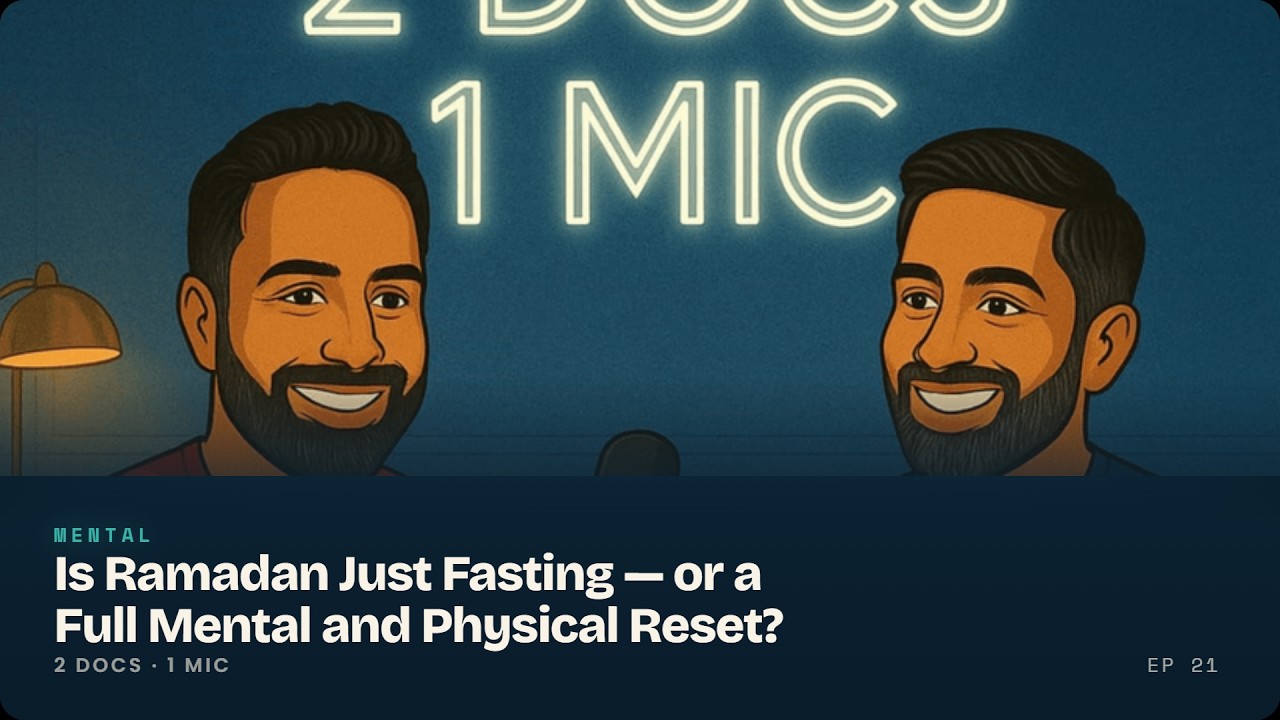
About this episode
Recorded on day two of Ramadan, Dr. Humayun Naqvi and Dr. Adil Ahmed explore whether fasting is a full mental and physical reset, covering caffeine withdrawal, discipline, and the metabolic science behind Ramadan-style fasting. As a preventive cardiologist, Dr. Naqvi explains counseling diabetic and heart-failure patients on insulin, diuretics and Jardiance, why cardiac events cluster at iftar, and shares data showing reductions in systolic blood pressure, A1C, LDL and triglycerides. They also dig into continuous glucose monitors, the gut-brain axis, wearables like WHOOP, and Peter Attia's fall from grace in the Epstein files.
What we cover in this episode
- Does Ramadan fasting lower blood pressure and improve metabolic health
- Why do cardiac events spike at iftar when breaking the fast
- Counseling diabetic patients on fasting with insulin and diuretics
- Intermittent fasting and time-restricted eating benefits
- Continuous glucose monitors and personalized nutrition
- The gut microbiome and how food affects individual glucose spikes
- Wearables like WHOOP, Oura ring and health data privacy
- Fasting effects on LDL, A1C, triglycerides and insulin resistance
- Caffeine withdrawal and dependence during fasting
Full transcript
Man, >> when you have that first cup of coffee after uh breaking your fast >> that just hits different, you know? Uh >> dude, it's like the thing I need the most, man. when uh when it's if our time and the fast is over, having that cup of coffee, dude, it's just I mean just that that has built all day. >> Yeah. You know, your your mind is just so dull and that f first jolt of caffeine that day just it just opens you up brightens your day. >> I know. >> Nothing like it.
>> It's just how much like caffeine withdrawal I'm living my life in at all times. >> Yeah. Yeah. It's it's the worst. I read this book. It's called uh it's a funny book. Uh I mean it's not a funny book but the name is funny. It's called your mind on plants >> and uh you know this this guy he does a uh he talks about different drugs and what your mind does and the first chapter is about caffeine and what your mind does in caffeine.
He does a self experiment on himself where he he's a big caffeine addict and he goes without having any caffeine for 30 days, you know, or or two months and then, you know, completely clears out all caffeine from his body and then eventually when he has that first uh drink of coffee, he explains his experience of how he just starts seeing the world differently. And I relate to that every day after a day of fasting. >> Yeah, no kidding, man. I mean, caffeine is like the most common drug of abuse.
So, it makes sense. But yeah, dude, with fasting, you know, for for the listeners now, we're we're talking about Ramadan, uh, the Muslim fasting month, um, which is upon us right now, today's day two. And so, we're in the thick of it. And I I find the first few days always to be the hardest. And then, you know, it's like anything, you kind of get used to it.
But for me, the first couple days, first two, three, four days, um I just find myself like no matter how much I eat or drink, you know, before sunrise, I wake up early and do the sahour, you know, getting some food in me, some water especially, it makes no difference. Right around like noon, 1:00, I always start like kind of dragging, getting a bit of a headache. Um, and then, you know, as like the the month goes on, I guess your body gets used to it.
That doesn't really happen anymore, but at the start it always does. >> I don't know about you. >> For me, you know, it's not even the food. I honestly do not get as hungry or it's it's a lot of time it's uh the whole like drag after lunchtime around after 12. you know, I'm I'm really good between 6:00 a.m.
till like 1:00 and I'm active and I have energy and I'm doing good and then I just start feeling the crash after 1:00 uh and start getting tired and sleepy because I haven't had caffeine and I think for me like fasting truly is about caffeine because I'm such an addict and you know my body is dependent.
That's why the first few days are hard, but as as the as the month goes on, then I kind of get adjusted to it because for me, as I'm going through the day, I'm drinking coffee, some kind of coffee throughout the day. Uh, and when I I'm not getting that, it it's tough. But, you know, I I uh you start off with having, you know, waking up early and like making yourself a nice breakfast and eating it. And then as Ramadan goes on, uh I just just just stop eating in the morning, too.
you get tired, right? And you just don't wake up early enough. That happens to me, too, man. You're just kind of like, ah, I'm just going to drink a glass of water, maybe eat like a banana or something and just suck it up. But that just makes the day harder. >> It gets, you know, it makes the day harder, but as as as the month goes on, you get used to it. You get more and more used to it. So, in the beginning, I think you need that food.
But as you don't care, I just, you know, wake up sometimes, eat a day, drink some water, and call it a day. And you know, >> yeah, >> you just spend the morning kind of like slowly waking up. Uh >> last year I used to make a >> just a cup of espresso in the morning and just chug it right before the >> There you go. You know, >> yeah, I I have a big cup of coffee when I when I start um the sahur the uh the meal before sunrise, you know.
Like today uh we were talking a little bit like I I woke up early. I just happened to wake up at like 4:30 in the morning for no reason. And I looked at the clock and I was like, "Man, it's like a little early, but whatever. I'm already awake." So, I I went and I actually made like a real breakfast. I had a four egg omelette. I cut up some mushrooms, cut up some tomatoes, fried them first, and put the eggs in there. And I had all that with a bowl of yogurt and a date and a banana.
Um, and then a bunch of water and a cup of coffee. So, it was actually like a lot of food. I felt so bloated for the next hour, but I thought that would hold me over really well. I was like, "All right, that's quite a bit of food in the morning." Same thing happened, dude. Right around like 1:00 p.m. my head starts hurting. I'm like, gosh, dude. I am You're really realizing how addicted I am to coffee. >> Yeah. But, you know, that's the whole point of Ramadan, right?
I mean, you there's a few I mean, there's a few lessons from it, right? The big part is like that discipline of like, you know, waking up in the morning like, you know, persisting through it, staying at it. There's days that the, you know, your mind tells you, you know, maybe if you skip a day, it's okay. you know, you you kind of start feeling that burnout, but persisting through it and completing the 30 days that you know, there's it builds certain kind of discipline and perseverance in you.
Uh, and that's a pretty good built-in uh system of of doing that. Now, forget the food, forget the water. The other thing I think it does it it, you know, throughout the day, it just keeps reminding you of of the struggles that people can go through, right? I mean that's I think the initial idea behind it that as you're uh abstaining from fasting, abstaining from uh uh drinking water.
You also think about not committing any sins such as hurting someone or or um you know saying bad things about someone or getting angry. controlling your anger, like having that self-discipline of controlling your mood, your anger, having a calmer uh mind and knowing that you haven't eaten and you and not haven't had that drink.
It kind of keeps you you you reminded that you're fasting and unconsciously you make an effort to not lose your temper, not get annoyed, you know, or or do things that otherwise would hurt people. So that's the that's the second thing. And the third thing is I mean you know um I think fasting overall is is is very good for you.
Uh and uh fa a period of fasting through the year kind of builds there's a lot of metabolic changes that your body goes through and we we'll talk about some of those later as well but I think fasting it's a way to build discipline. I mean, if anything, people can do it for religious reasons, non-religious reasons, but once a year giving something up, uh, having a month where you force yourself to commit to something builds a lot of discipline and perseverance. I think it's it's a great month.
Plus, we get to see a lot of our friends and families and, you know, the fun meals at the end of the night and, you know, stuff like that. So, it's it's a fun month for me. >> Yeah, it's it's a lot of it's a lot of good traditions, too. And you know it's stuff like I mean a lot of the major religions have a a version of it you know there's there's a type of fast in Judaism and Christianity too.
you give up something for Lent in a lot of Christian denominations, you know, but like that and that's what I think beyond just the food and the water because that's what people talk about. That's what people see and that's what so commonly people associate with Ramadan, but it's like it's just the month of temperance, right?
You know, you're kind of purposely depriving yourself of the food and drink during the daylight hours, but it's it's meant to free your mind and free your time to really be a little more spiritual, a little more meditative, pray more, and do more stuff.
you have time now because if you think about we we spend a lot of time like in an average day about food whether eating the food preparing the food cleaning up after food it takes a lot of our day um you don't really have to worry about that during Ramadan and ideally you would use that time to do something productive um and you know you can establish good habits during that month like things like prayer um or reading a little more and hopefully carry those on so I think it's like it's like a nice reset um during that month.
That's that's what really like does it for me. That's what I like about it. >> Yeah, for sure. Like you know the meditational and spiritual aspect of it is really appealing. You do feel a certain u type of spirituality during this month uh because you're fasting, you are dedicating, you are uh committing to something you know either you're religious or you're not religious.
I know some people now that have started to they're not Muslims but they've started to fast during this month just because to to kind of participate in that but there's also that they see the benefits of you know that spirituality the the self-discipline that comes with it. So, you know, I I I think it's it's a fun one, but there's a lot of fun uh eating going on too that you know, in terms of as a cardiologist, I think about it.
I I talked to a lot of my I have I have patients who are Muslims and fasting as well. And you know, that that topic always comes up, you know, none of my Muslim patients want to do stress tests during this month. They're like, "Oh, can we wait till after Ramadan?" And so, you know, and then, you know, you really have to counsel patients. You know, there's some patients that really adamant about fasting.
Uh they they really want to do it, but they're elderly, they're frail, they're they're uh you know, they're diabetics, they they need insulin. Uh they're on diuretics as well. So fasting for them, uh there's a lot of uh there's a lot of excl um you know, exceptions in in Islam about fasting as well. And you know, you have to keep reminding your patients that hey, I know you want to fast. I know you um want to participate in this. It's a fun month.
everyone wants to do it because you know it's it's it's you you're doing it as part of a collective right uh so really have to discuss with my elderly patients kind of come up with strategies of what you're going to do especially you know with their insulin like you know uh if they're diabetics or they're on certain medications like you know fara or jardians where they could get a little bit more dehydrated right uh that's that's a big conversation item and I might be the only Muslim physician they have who can properly counsel them on that.
So as a physician who sees a lot of Muslim patients, that's a big conversation piece that comes up. You know, some of the things that we talk about is, you know, their blood pressure. Uh you know, if someone has hypertension, yeah, Ramadan uh fasting does fasting generally since you are abstaining from eating uh drinking a lot of water there's there two things can happen.
One thing can happen that people who are a little bit more disciplined can their weight their blood pressure can decrease a little bit, right? So the medications they're currently on may be a little too strong for them. They might get some dizziness or lightadedness from taking those medications. So you have to counsel them. Hey, these are the symptoms to watch out for. And if you have these symptoms, maybe cut this dose into half for this medication, for example, right?
But then there's some other people that are, you know, they have congestive heart failure. you know, they they get edema very easily, shortness of breath pretty easily, and you know, our our foods, the the the foods that you break your fast with can be very uh salty, mostly fried foods, uh very >> Yeah, it's a it's a big salt load right after a a 12 to 16 hour day of not eating anything or drinking anything. >> Yeah. Exactly.
So and there are studies that have shown you know they've compared uh um Ramadan fasting versus non-fasting days and the there was not a significant increase in the amount of uh cardiac events in those patients but when they looked at it they saw that the timing of the cardiac events in patients was very particular to the breaking fast time you know the thar time >> that's when most of the cardiac events were happening in patients >> so there's clear data on that because people people, you know, they overeat, overindulge.
Uh, and that's another conversation I I need to have with my patients when we counsel them on fasting of what to watch out for, what not to eat if they have congestive heart failure, right? That's a big part of it. So, >> yeah. And you know that it's interesting too, just, you know, like the spirit of Ramadan, like the theme of fasting and kind of like being okay with depriving yourself just a month in the grand scheme of food and drink.
It's also kind of like you shouldn't like look at the clock and as soon as like okay sweet it's zifar time to break the fast then you just gorge a bunch of it's like >> you know even if you look at like historically in Islam and just like the fact-based history of it and when the religion started >> that wasn't what people did you know when it was time to break the fast and it was time to eat they had very minimal like a date and some water and then they would go pray and then they would talk and you know like it wasn't about just okay now it's time to eat.
Let's just have a buffet. That's that's not like I don't know. I mean people do whatever they want. I'm not trying to tell someone how to follow their religion. I'm just saying that's not supposed to be what the idea of breaking the fast is is all right let's go to like a Brazilian steakhouse and stuff our face. >> You know it's fun when you're at a party or a gathering, right? The the festive environment is important and a lot of socializing just for all people centers around food.
So that's just a thing when you go to when you go to gettogethers um during Ramadan. But I I think that's kind of what you're saying that you know what the data shows the real science and the studies show that cardiac events are more likely to happen right at the time of breaking the fast because I think that's when people are just excited and that's when they would gorge some food. >> Oh yeah. Exactly.
I mean if you if you look at the diet of you know very religious people, religious scholars that you know if you interact with them I see their diet and it's very simple you know most uh people who are religiously inclined or are scholars of the religion or you know they they eat simple things like yogurt, honey, dates uh and that's what historically was how the the fast was broken.
It wasn't overindulgence with fried pakoras and samosas that you know a lot of a lot of we a lot of uh people in our culture tend to uh uh eat during ifar. So I think u I think maintaining that discipline during the day but also maintaining that discipline during time uh is very important and this that's not a time to just gorge yourself with food and you know stuff your face and eat all kinds of unhealthy food.
Uh I think you have to keep some kind of uh restraint during that time as well you know.
So that's that's definitely but you know um there there are uh it just makes me think of you know as as medical professionals you know our lives you know we we we counsel patients but uh on on their fasting but throughout our training you know uh fasting in Ramadan creates a lot of challenges right I mean I remember >> dude during training even even now >> even now yeah I mean now getting through a gruesome clinic day or a procedure day while fasting can be can be tough.
But I just remember back to when I was in I was just thinking about this the other day that I I was in you know I I think I got through college and that was fine but when I got to medical school and that after you end up your second year when you're uh studying for step step one and there in the library all day you you need coffee you need food to keep your mind focused fasting all day in those longer days because I think back then Ramadan used to be in the summer time too that's you wouldn't break your fast till you you know, 9:00 p.m.
>> Yeah. >> And some days >> and there was I just could not focus on studying during Ramadan. That was that was tough. >> Yeah. >> There were quite a Muslim kids in my class and we all used to try to do as much fasting as we could. But uh just getting through the gruesome day from like 4:30, 5 in the morning till 9:00 p.m. in the summertime is I'm glad that's over now. I don't think I'll have to fast for summer till I'm probably my 60s. >> Yeah, it'll it'll be a while till it comes back.
You know what's funny?
I think like not like in medical training but just like in life in general like out forget medicine even for a moment is just the most common question I've always gotten in Ramadan when it's Ramadan time from friends from random acquaintances is like you're telling them about Ramadan yeah we don't need to drink anything it's 30 days whatever they're like even water >> water >> wait not even water yeah I'm like yeah bro it's like no food or drink like nothing they're like but nothing Like what about water?
Like water's a thing, dude. It's just >> Yeah. No food, no water. It's it's the whole thing. >> Yeah. I mean, you know, hydration is important. I get that. I mean, I hydrate myself before and after quite a bit. >> Hydration, but for that for that period of time, you don't drink water. I mean, how hard is it to understand? >> I've been saying that since I was in high school. I was I've been telling people I think some people know and they still ask about water. >> I know. I know.
I think I I get asked that once a day. >> And then at least growing up, you know, like me like my friends, we would all just mess with each other constant. It was like our default method of communication was just roasting each other. Like you see each other's face, you're like you're like I'm going to mess with them now. Constantly my friends, you know, who weren't Muslim, weren't fasting, halfway through the day be like, "Dude, have you cheated yet today?
Did you have a French fry lunch?" I'm like, "Dude, no, I didn't." But there's constantly.
And even like I still remember in residency, you know the funny I had one attending he um he would always always during Ramadan mess with me, you know, I was a resident, you're working hard, you're doing night shift, you're on call and stuff and like I'd be sitting there at the computer typing a note or come in with like split material on my arm and just put a cast on someone to the ER and come tell like you know the rest of the team, hey, we did this. I'm going to add this guy onto the schedule.
And he would just look at me and he's like, hey, we can go to the lounge and I'll get you yogurt. I was just like, dude, like just constantly trolling. But I mean, stuff like that is funny. I never took it bad, but I think it's hilarious that people like, you know, they just like to mess with you. Um, when you're kind of in a way the odd one out, like you're following your religion, and it's something that's visible.
You know, everyone else is eating at lunchtime, a rep, like a rep or device rep or someone brings food, everyone else is chowing down on some wings in the in the O lounge, and you're just kind of sitting there.
Yeah, that's you know that's the that's the challenge right throughout uh throughout residency um one year I mean you know we we'd have like conferences every time we'd had moon conferences and luckily you know in internal medicine cardiology is just full of Muslim people so you know it would be my my class in my fellowship uh there was six of us in our fellowship class and four of us were Muslim >> oh wow Uh so uh and I think half the program was Muslim Muslim guys and some girls as well.
Uh just because in cardiology and in internal medicine there's such a prevalence. Uh so even the reps that would bring lunch they would bring me tons of food and we would be sitting there and no one would be eating. >> Funny dude we didn't even think about this. But now I think >> I've had I had a flurry of reps bring food to my lunch right before Ramadan.
uh and it was a busy time for them too because so many physicians you know everywhere are Muslim and it's so common in in physician circles that most of them are fasting that uh the reps know you know most of them know that when to bring lunch and during Ramadan not to bring lunch >> yeah so I had almost every day this past week uh someone bring lunch until the the last day of Ramadan because >> there you go get it in right before Yeah. The general the general awareness has definitely increased.
I love it. I think it's awesome. I mean, you even go to like grocery stores like HB and stuff and you see like a Ramadan section. Uh like my my wife Sam, she she just bought cookies from the grocery store that were like pre-made in, you know, tradition shapes like crescents, minoretses and stuff like that from the grocery store that came with little packets to decorate them. So like, you know, the kids could decorate cookies with different stuff. Uh I mean little things like that are cool.
Like schools are doing more stuff.
like your kids school is um >> yeah I mean celebration for drove them to uh the drop off and >> I drove by and I knew the parents were going to do something uh because we had a group text going and parents were going to organize and the whole school was decorated in Ramadan decor uh and uh you know balloons and lanterns everywhere and the door was decorated and there was like inflatable balloons all over the place with Ramadan signs so it was awesome you growing up um in the '9s and the early 2000s like you know you feel you felt pretty excluded you know you you were the odd odd one now uh everyone else's holidays were were celebrated and everyone else was uh you know Christmas and um all the mainstream holidays in in the US were celebrated but you know as a Muslim none of none of our holidays were at that time uh part of the mainstream no one really knew about it whenever you'd say oh yeah I'm fasting like people for what what is what is that?
There was not just as much uh information and knowledge about it. And it's great to see uh finally the capitalism uh taking its place and Ramadan has become mainstream where you know they're starting to make money off of it as well. And it's it's good to see now we're becoming mainstream as well. >> Yeah, exactly. That's where it really shows. If you have a Hallmark card, that's when you've arrived. >> Yeah, you were right. You know, Party City has their without section. HB has section.
So, >> which you know what's what's crazy is just like like historically, you know, like Thomas Jefferson way back in the day, right? Thomas Jefferson hosted a Ramadan in the White House, you know, like one of the founding fathers, the cat that wrote the Declaration of Independence. So, like there's been awareness of Ramadan and fasting from basically the very beginning of the US. it just has never been mainstream in the public consciousness.
You know, >> there's a there's a very uh interesting book about the first Muslims in America and it talks about how the first Muslims in America came in the 1600s through the slave trade and most of the slaves that were brought in were actually Muslims.
They practiced their religion for a while and they they were practicing Muslims and they eventually had to conceal it for many years >> and practiced secretly and and those those people and those Muslims had own stories to tell and after uh there was emancipation there were stories written about them and they wrote their stories about them practicing the religion. So Muslims have been part of this country from the beginning have been part of it.
uh now we're growing, we're we're we're getting more uh you know getting into leadership positions uh into politics and we'll always be part of the country as Americans no matter what anyone says, right? No matter what uh kind of Islamophobia is is is uh is spread about Muslims and uh all these people trying to gain notoriety through uh their hateful speech in politics. No matter what they say, uh we will be contributing citizens. We're we're we're physicians. We're engineers.
Uh you know, we're we're leaders in society now. Uh and we're playing a big part in building this country and no one can take that and I'm I'm glad that that's finally being recognized as well. >> Yeah, for sure. I mean, it's it's getting more and more popular. Um and it should. >> Yeah, >> I think it's great. >> It's great.
So, but you know uh going back to the the training I just I was reflecting on on that as well like you know one year that was the best time when you know somehow during Ramadan I ended up being on nights in the CCU. >> Well that's a good time and >> that you know that was uh I I start literally my nights started like the first day of Ramadan >> like this cannot be any better. It was a month long It was meant to be. That's good.
>> My schedule was so fun because I would I would I would get to the hospital around 7:00 and I think you uh you would break your fast at 7:30, 7:45. So I would bring my food with me. I would get to the hospital, eat dinner or, you know, break my fast, have the whole night to just, you know, snack on or do whatever. >> Yeah. >> Get home by like, you know, uh I forgot what time was it. Get get home, do my sore, and then go to sleep. Uh, and then sleep till 3 p.m. 3:30 p.m.
wake up, set some time, and then so that was the easiest Ramadan I had. There was no difficulties at all. >> Yeah. Yeah, I know. That's good, man. That's good. You know, like I I think like looking back at training especially because, you know, you just don't have as much say over your time or it's you're a little sheepish or nervous to like request any special accommodations. You know, you just kind of want to put your head down and do the work.
I remember this I this I think this was during fellowship. I'm trying to remember. It was during Ramadan and we we were doing a case where this guy had come in and had cut off four of his fingers. We were reattaching them and you know that that takes like a lot of time to reattach a severed digit. You got to fix the bones, all the tendons, all the nerves, all the vessels, close the skin, and you got to do all those are really tiny little arteries and nerves in the fingers.
And you got to do it under the microscope. And it takes a lot of focus and it's very easy to lose focus or get distracted. Like the mental concentration is is much more difficult than the physical task, but you got to like you little microsurgical instruments. You're working with suture that's tiny. Dude, I remember it was like time to break the fast. And we only had like one and a half of the fingers back on. The other two are still sitting on the back table.
And we're like working cuz you're on the clock. If the fingers don't get reattached and the blood flow gets back into them, they die, right? They get eskeemic and you're like, "Oh shit." Like we really got to work here. And dude, I am like getting delirious sitting there under the microscope. I I'm like I'm like blinking way more than I usually do. And my attendant looks at me and she's like, "What's wrong with you?
Why are you blinking so much?" And I was like, "Dude, I'm like having trouble seeing right now. I'm like three hours beyond the fast time. I haven't eaten anything." And this was like in the summer. >> Yeah. >> So the the daytime was already like 16 hours. So I'm going on like 19 20 hours. I haven't eaten or drank anything. And I was like, I think I need to scrub out and like get some water or something. And dude, I didn't even get real food. I just walked out of the O.
And you know the scrub sinks where you just wash your hand and sterilize. I just turned the water on. I just put my mouth. I am. I just started chugging some water. It's like splashing all over my neck, going down my scrubs. I didn't I was just like, dude, I just need some water. I like washed my face and went back in there and we put those other fingers back on and the hand lived. But oh man, it was a miserable miserable case.
>> Yeah, you know, uh especially in the O, you know, you guys do spend long hours. I mean, none of my procedures are that long and but you guys, you as surgeons, you spend long hours and definitely there's times when the case can go long and go past the the hours, you know, go past >> all the time >> and you can't sometimes you can't take a break. You're the main guy doing it. You can't there's no way to take a break and you just keep going, right?
I remember once when I was a medical student, I was on my surgery rotation and uh it was during Ramadan um and uh we had a whipple procedure was which is a removal of a >> uh cancer and usually are known to be long procedures uh and we were going in at at 3:30 p.m. 4 p.m. And I was like okay definitely I'm staying past the time for sure >> 100%.
And uh you know um the surgeon cut open and we went in and then uh he started feeling and uh and then kind of analyzing and he realized that the cancer had spread too much uh at that time and uh he was like yeah I don't think we can remove this and he just closed up. So unfortunately the case ended in like 30 minutes and 45 minutes and I felt bad. And I was like, you know, this is this is really bad cuz I really feel bad for the patient, but I'll I'll I might be able to get back home for a thar.
And that was a certain like uh like just >> you feel conflicted, right? Because selfishly it worked out in your favor at that moment, but obviously it was horrible for the patient. And like it's a natural thought. You're like, "Oh, well that sucks." >> Yeah. >> But now I get to go home early and you feel bad, >> right? You get so you get so uh you get so uh you started seeing things so objectively that you were just like, "Oh, yeah. The case, you know, this is what happened.
The case ended supposed to end at 9:00 p.m. and ended at 4:45 p.m. I'll be home at 5." >> And then you realize you're like, you know, that's just a horrible news for someone else that I I'm just kind of feeling relieved over, but that's not really, you know, you have to reflect on it and you're like, that that's just sucks. I felt guilty afterwards for for many days for even feeling like that, right?
But uh you know your your instincts sometimes take over and you have to kind of remind yourself that the profession you're in there's real people and real consequences of uh dealing with things every day right. >> No for sure.
You know what one thing too like in um like even now not just in training even now like during Ramadan like today for example like I had an O day today and you know depending on the type of case like it's not that big of a deal but today I had a long case and we're taking a lot of X-rays so I was wearing a heavy lead vest just you know to protect myself from the radiation.
It was a elbow fracture and you know the patient was a little sicker, wasn't doing too well and so it's important to like maintain the body temperature high because when the body temperature drops a lot of negative stuff starts happening. Um and so the room was really hot and we're already wearing the lead and you're gowned up and you're working, you're trying to drill, put a screws in and all that.
Dude, I was sweating so much and I was just like and you know you're talking so much in the case you're telling the residents what to do. You're explaining what you're doing. My mouth is getting all dry. I'm getting cotton mouth under my mask. I was just like, dude, this case sucks. I want to finish this case and move on. >> Especially when you have to teach, right? Especially when you're, you know, >> and some people just get irritable when they're hungry or thirsty.
And, you know, and then on top of that, having to teach, you really have to kind of maintain that uh mindfulness that hey, you know, this is not anyone's fault. This is my what I'm doing. This is my mind that I have to control to make sure that I'm not getting irritated by someone. I'm not getting losing my temper easily. It's a big part of it. You know, I get hangry like there. The hangryness is a real thing. >> It is, man.
But yeah, it's like it like defeats the whole purpose of Ramadan and fasting if you just start getting pissed at everyone because you're choosing to do it, you know? >> Yeah. Yeah. Might as well just not do it then. If you're going to be, you know, some people just, you know, they're like, I'm fasting and I can't do this. that uh you know if you're going to be angry and and kind of just all you want to do is just stay at home and just stay in bed all day.
I mean that's not the purpose of fasting, right? Go about your day, make sacrifices, >> you know, that's what the whole point is teaching. It's not just to stay hungry. I mean, you know, uh abstaining from food and water is one part of it, but the whole idea of that self-discipline, a lot of people tend to tend to lose that idea, you know. >> Yeah, they do. They do. And you know that that's another interesting thing to think about, right?
Like the religion is not meant to be hard or ownorous for you. And there's so many concessions like you were mentioning. I mean, people who have real metabolic disease, diabetes need to be on medications. Pregnant women, you get a fever and you get sick, you know, like anything like that, you you do not have to fast. It's totally excusable. That that's like a very well-known thing.
So it's not like a torture, >> you know, >> especially if you're nursing or you're pregnant, >> you know, if you're diabetic, you have heart failure, for any reason, any reason that you feel you cannot fast, there's excuses for that, right? But there's a lot a lot of benefits to fasting as well, right? There's there's known documented benefits of fasting and as as we know, timerestricted fasting or timerestricted eating is a big part of the American fat diet.
Uh, and ideas that, you know, people talk about intermittent fasting. There's so many people that ask me on a daily basis about intermittent fasting, about fasting and you know uh within within um I I always kind of think back to Ramadan times where you know this fasting is built into the religion and we do this every year and and there's a certain health benefits from it. There's definitely studies, right? There's studies out there that have shown certain health benefits.
I mean, you know, there's it's it's shown that Ramadan style fasting can have a have an effect on your on your blood pressure, on your LDL levels, and your insulin resistance uh and your triglyceride levels uh and over overall metabolic state. So, there's that one study I think we're looking at is the Lauran study and that that showed almost 8 millimeters of mercury reduction in your systolic blood pressure uh during Ramadan, you know.
um uh same thing with a reduction in hemoglobin A1C of almost uh 3%.
uh you know improvement in your plasma glucose levels of almost uh 16 points a total cholesterol reduction of 13 points uh LDL reduction of five uh so >> yeah so I mean basically it's like all of the traditional you know like metabolic chronic diseases like high hypertension high blood pressure hyper cholesterolimeia diabetes or pre-diabetes obesity itself all of these things are actually helped and improved through some type of fasting >> for sure and even even They they've they've done studies where they've shown that uh the incidence of hypoglycemia or low blood sugars because of fasting is ne negligible.
uh you know people who are not fasting versus fasting they did not have any more EV episodes of hypoglycemia you know uh so there there are beneficial effects I I do personally believe in the gut hard brain access where what you're putting in your body has a huge impact on it right there's numerous studies not really studies but numerous anecdotes and ideas of people now more and more often using CGMs a continuous glucose monitoring devices to uh kind of capture their day.
And we know that uh what you put in your body can have a certain impact on your body. So for example, like what when I put if I put on a CGM uh and you put on CGM, if I ate a piece of sourdough bread, uh my um increase in in blood sugars might be much different than yours. And for some people, there may not be an increase by eating a certain type of food. Whereas for some other people there might be a jump or a spike in your in your blood sugars level. Right?
So what how your gut microbiome is uh how the gut bacteria has developed and what the the microbiology is in the drug can really impact how food affects your body and fasting has shown to reset that and alter that as well over time. >> Yeah. And you know, it really shows like how different each individual's own like insulin sensitivity is.
Like if you are very sensitive versus not sensitive to insulin compared to your friend who's also using one of those continuous glucose monitors, that same sourdough slice or same slice of pizza or a banana or whatever may spike one person's glucose like very rapidly and the other one kind of stays at a pretty consistent baseline. And you know it would be interesting to see whomo like the same group of people.
I think this would be a fascinating study to really see the same group of people doesn't change anything about their diet or lifestyle and just monitor the relative spikes and troughs in their blood glucose over time with their basic diet, basic exercise routine. And then you put them on a timerestricted feeding type uh regimen or a Ramadan style fast type regimen.
And now you add in addition to those uh things you add other variables like exercise or even something as simple as just taking a walk after dinner and does that mediate a bit of that spike you get in the post dinner glucose level or not? You know I think like the the ubiquity of data like that I mean people are tracking everything up. Everyone's got an aura ranging on. People have this continuous glucose monitors. Everyone's got a smartwatch watching their sleep.
these like little granular data points that populationwide I mean it's huge toms of data that all of these lab tests you know when we have patients routinely just check a fasting glucose you know once a year as part of routine labs that's very different than what their regular daily spikes of glucose are actually doing and what they're doing in real life because in real life people usually aren't fasting for that long that's just to get the blood work I think that's like a huge thing that has yet to be tapped really >> well no it is not yet to tab is being tapped aggressively right now.
I mean there's uh large companies you know that that have come out with uh direct to consumer CGM devices. So Stell is one of them. >> No the CGM devices are there. Well, that's not what I'm saying. Like I was just mentioning that I'm saying that us as doctors have not tapped into an ability to take action on that on a large scale. Like we're still relying on let's check your fasting glucose every so often, right?
rather than like I mean maybe you do this I I don't know any doctor that regularly looks at patients continuous glucose monitor data as a routine. >> Yeah. Not you know so there's there's a lot of people in the longevity space that are doing exactly that. Uh yeah, you know, we we've talked about some longevity doctors that have recently got in trouble with the with the with some of the files that came out and in the internet, >> like the most famous one, Peter Aia, right?
I mean, >> I I feel bad talking about him, endorsing him in the book that I read and then comes out he's uh been doing some horrible stuff on uh you know uh through the Epstein files. But >> dude, I mean, I think that's an important thing to say.
Like, yeah, I think both of us in the past did speak in a positive way about Peter Aia and his message and all of that based on the message of his podcast about longevity and health, but now that his name has come up multiple times in the Epstein files, a lot of the stuff he even said in there is like heinous. I mean, I think it's reprehensible. I mean, there's no other word for it. It's is disgusting. >> Yeah.
And it shows you the, you know, the the whole idea of this, you know, so many people as you get rich and famous, your your mind just so easy to get corrupted. And, you know, these people >> uh have a certain facade and they they they act that they're, you know, but he was charging his patients 150k a year, you know, to see when when when a physician is charging that much money and wearing fancy watches and, you know, there is something shady going on behind the scenes.
you know, the his message was was good. He was he wrote a good book. There was good ideas in it. But you doing certain reprehensible things like what he did uh what's stated in the Epstein files or what he allegedly did uh and what's implied in those files, it's kind of puts me it made me very shocked and disappointed because I really liked his stuff. Right.
disappointed is the perfect word and and disgusted, you know, like I just don't understand what is like this unifying sickness in people that are like in this class of society that we call rich and famous. Like what is wrong with all of them? They're so depraved. I mean, like I I just don't understand it. It's absurd. Like every other day, every week, you see like a new name of some famous dude who has shown up in the Epstein files. Like a bunch of pedophiles. Like what the hell is going on?
Yeah. I mean, like >> the the if you as you get more rich and famous, you you just incline towards pedophilia for some reason. >> I totally What the like it's ridiculous. >> Yeah. I mean, at least at least, you know, there's other countries where they found like in the UK, they're doing something about it. They're making arrests. They're holding people accountable. The people here in the US are just roaming free with no consequences.
They're >> still maintaining their seemingly truly above the law. I mean, they have these like I don't know, bought and paid for attorney generals and stuff just like putting up shields for them. It's wild. >> Yeah. But we went on a tangent about that, but you know, we're talking about uh the whole idea of watching >> Yeah. Back back to glucose monitoring. >> Back to glucose monitoring. But a lot of a lot of people have been advocating for continuous glucose monitoring.
We don't have real active data on how CGM devices and non-diabetics impact weight loss and metabolic disease, but a lot of the wellness and longevity doctors uh uh make CGM a big part of their practice. A lot of concierge doctors uh are making CGM a big part of the you know and now you can get devices like Stell which is I think made by uh Dexcom uh for like $99 a month, right? Right. So, $99 a month, you get two patches. You can put put them on and and kind of just monitor your your glucose.
Uh there there's been a few apps and I I've explored a few of those apps like Neutriense and uh a few others where they analyze all that data and give you nutritional advice based on your glucose uh spikes, what you ate. So, for a month, you keep a diary. You also can talk about when you fasted, what times you fasted, what your blood spikes, sugar spikes did, uh what foods you ate, what foods you broke your fast with.
And based on those readings, uh they make a comprehensive uh dietary plan for you, which I think is is the future with especially with the advent of AI uh coming into it that the AI will be able to really analyze that data and give you really uh granular information about what kind of things suit you. uh what type of breads are good for you, what type of vegetables good for you, and what type of fruits and vegetables are not good for you, right?
So, because we always advocate as part of the Mediterranean diet uh you know, eat fruits, eat vegetables, but you know, there's some fruits that might not be as good for you or some vegetables that might not be as good for you compared to some other ones. And and with these apps and CGM monitoring, there may be an application in the future where we might be able to customize diet. Right. Right.
That's why, you know, nutrition counseling has been such a shitow because no one exactly knows what's going on. No two people are the same. You know, some person might really benefit from a keto diet and the other person may not at all and their lipids would just jump up versus someone else may benefit from a Mediterranean diet and another person may not. Our our whole biology is very different.
we're you know individual individuals with different um DNA and you know the microbiome and how our body reacts to food is very different. So I have a lot of uh excitement about the CGM devices. I was actually thinking about doing CGM monitoring on myself for this month just buying a stellar monitor uh from Amazon. It's easy to order. I was looking at it.
You can buy it for $79, $80 for the whole month and just use it and just track my foods and my intake and see how fasting is helping me and affecting me. >> Yeah. I mean, it's it's fascinating how many people are using it, you know, like you know, it's funny like I'm noticing it because I do a lot of shoulder surgery.
So, I get a lot of shoulder X-rays in clinic and dude, I'm telling you, like every clinic I have like four or five people that on I'm looking at the shoulder X-ray, they got that little white little circle like here on their tricep, you know, the glucose monitors. And a lot of people are using it. I mean, I think it's great. It shows kind of like the theme we've been talking about in prior episodes.
The average person in society is getting much more in tune and interested in their own health, in their own data, in their own numbers. And more than anything, I think the populace at large becoming interested in seeking this out is what's going to even more forcefully drive this whole idea of personalized medicine.
And like you're talking about with AI, I mean, people down the road could legitimately have their own like AI agent that does nothing but give them recommendations based on things like C continuous glucose monitoring, things like nutrition, like what is specific to you. And what's specific to one person may also vary within their own life or within their own time of day.
Not necessarily from person to person only, but even temporally within one person, you know, like I'm very different right now at the age of 35 than I was a decade ago, you know. >> Exactly. >> Yeah. Just having the data, you know, I personally uh have the the the whoop uh which has gives me a lot of data.
And what this hoop can do also is >> wait >> it's called whoop wh hia whoop >> and what it can also do along with like kind of tracking my sleep uh when I wake up with the quality of sleep I get it can also track uh you know and predict my blood pressure based on my metrics cuz it's got to know me now and I've input manual blood pressure readings that correlate with it so it it predicts my blood pressure and whenever I I check my blood pressure against it it's it's actually pretty accurate Right.
So, uh this thing can predict blood pressure, predict my heart rate, uh my oxygen levels, if I'm developing fever, uh how much sleep I got, what was the quality of my sleep, if I have signs of sleep apnnea. So, there there's a lot of things it can it can it can track.
So having a device like this plus a CGM uh plus uh your activity trackers like you know or you know some kind of facial recognition or uh devices uh I think we'll be able to tell a lot about our overall health and get personalized recommendations by certain apps that you know and especially on top of that if you input your blood work like for example you get blood work through that app uh AI will be able to analyze your vitals through your the wearable devices, uh your labs, um your behavior patterns and kind of make a personalized care plan for you better than I think any physician that might be able to do that.
>> Yeah. Yeah. But you know the the other side of this coin is the potential for abuse, right?
is that we are giving so much of our data that wasn't beforehand regularly cataloged ever in human history and we you know like our rationale to doing it is I like for example if I use an aura ring or something or you're using your whoop or whatever someone is using they're using it because they want to know more about themsel and is there something that's actionable can I act on it right like it's one thing to say okay I had 42 minutes of deep sleep and then I had several nighttime awakenings.
My total sleep quality was rated as blank. You know, okay, great. What do you do about it now? Right? Just knowing it means nothing if you don't take action, right? But the other side of this that I was kind of alluding to is so much of our own data now is just being farmed and funneled into what? Into huge data centers, huge servers, a lot of it into these AI companies that are doing god knows what.
Several things we do know is that there is a lot of AI based targeted um surveillance that that's happening. I mean that's not even a conspiracy theory. This is pick up your phone, grab your laptop and Google it. It's happening right now. I mean companies like Palunteer, even Anthropic, I mean this whole thing with Venezuela with the US government intervention, it's they used the clawed anthropic system for it. Like this stuff is happening, right?
>> Anthropic was very bad about there's a whole >> they were about it, right? which is >> I guess good that they were pissed about it, but there's plenty of companies that are that size or even bigger that are not pissed about it, right? Like Palunteer, they're very vocal about wanting more of all of our data because once they can collect all our data, they know and can predict they can predict your oxygen level and your blood pressure. They can predict your next action, your next move.
They have the entire set of data on what makes homayo or what makes adil, right? So I personally am a little leery like I I don't have any a rings. I don't have a whoop. I don't got nothing. And not because I hide under a rock in the woods, but I just think we already have so much of our data constantly being mined and farmed. I just don't know how much of it for right now for me is going to be actionable.
And the costbenefit analysis of it just being subverted and used by some outside source versus me not really being able to do much with knowing, okay, I get a glucose spike at 5:00 p.m., but if I walk, it's a little less. You know, that that's my thought process on it. and why I'm a little less excited to jump into it. >> Yeah, for sure. I mean, as long as you're aware of those those risks and those those things that could happen.
I mean, the data could also be used because our the main goal uh of of this country and in this country is to for businesses to make tons of money off of you, right? I mean, targeted ads for your personal likes.
Just by knowing that, you know, they they might be able to track that when when people watch this kind of commercial or see this kind of product, their heart rates go up and and they get excited and you might start getting more targeted ads towards something like that where your vitals are changing based on uh a product you see or feeling you feel after seeing a pro product.
And uh you know our you know social media kind of started out as a innocent project of us writing each other on each other's walls and uh tagging each other in pictures and you know becoming friends on Facebook and now it's become a whole mass media marketing uh tool for a lot of companies to make money off of us. Right. >> Dude, it makes me miss Tom from MySpace. >> Tom from MySpace was the >> He was the OG, right? >> OG. He had no no intentions of uh causing any harm.
Was just wanted to be our friend. >> Then I look at what social media has become, what the promise was in 200 uh6 2007 and how excited we were and now how the the evil behind social media and how it uses all our data and all our information to target ads towards us. Right. So yeah, the same stuff. >> The promised land was a big farce. It's not the it's not the promise that we thought it was. For sure, man. What kind of what kind of tangent episode do we have just now starting off in Ramadan?
>> I like it, man. You know, the the not eating has given us the ability to think about other things. I'm not just thinking about burgers anymore. >> Yeah. No. Yeah. I'm not just, you know, but I am thinking about what I'm going to eat in the morning for my sore. >> Yeah. >> So, >> maybe some more coffee. >> Yeah. But yeah, interesting uh you know, times to come especially.
But I do want to give more and more information because as a physician I think I I have a better idea of making those changes and identifying patterns in my health. You know like why I had bad sleep, knowing those reasons and avoiding those reasons. And a lot of times I can track why I had a bad bad day of sleep and then less and less avoiding those activities.
And uh for me the glucose data is promising because you know glucose spikes and insulin spikes uh in the body cause adipose tissue uh buildup right and uh increase in weight. So watching what you eat and truly understanding how your body reacts to certain kind of food can really have an impact on overall metabolic health. And that's why I'm excited but I'm aware of all the the negatives of putting my data out there. So, you know, it's a it's a it's a calculated game.
You have to play to see what what what information you're getting out of it and what you're putting into it. >> Yeah. No doubt. No doubt. All right. I think that's a wrap. We'll say Ramadan Mubarak to everyone and we'll see you guys next time on Two Docs, One Mic. Right. Varic.
Your hosts